
2026 Market Analysis Report: Global Metal Shot Peening Abrasives Market Valued at US$258 Million in 2026, with Steel Media Dominating Demand and Automobile Applications Projected to Grow at 4.2% CAGR Through 2032
Published Date: Friday,30 Oct,2026


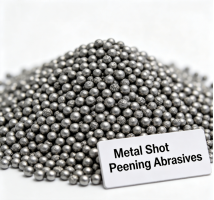
Metal Shot Peening Abrasives are metallic particle media used in shot peening, shot blasting, surface profiling, rust and scale removal, and the introduction of beneficial residual compressive stress. Typical products include cast steel shot, steel grit, cut wire shot, conditioned cut wire shot, stainless steel shot, aluminum shot, zinc shot, copper shot, and specialty alloy media. Compared with disposable mineral abrasives, metal shot peening abrasives are recyclable, controllable in hardness and size, stable in impact energy, and highly influential on peening intensity and coverage, making them critical consumables for aerospace, automotive, springs, gears, castings, forgings, steel structures, and energy equipment.
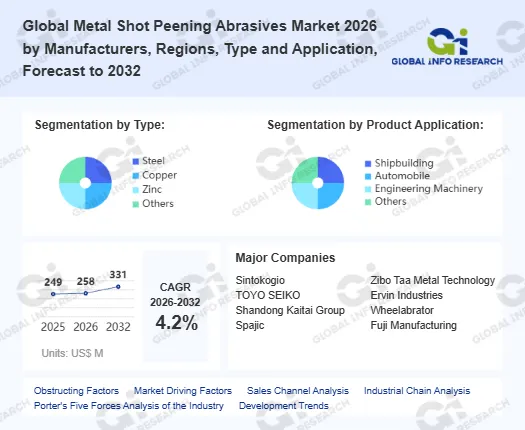
According to the latest report"Global Metal Shot Peening Abrasives Market 2026 by Manufacturers, Regions, Type and Application, Forecast to 2032" published by GIR (Global Info Research), the global Metal Shot Peening Abrasives market was valued at approximately USD 249 million in 2025 and is projected to reach USD 258 million in 2026. With a CAGR of 4.2% during the forecast period from 2026 to 2032, the market is expected to further expand to approximately USD 331 million by 2032. This growth is driven by increasing market demand, evolving industry trends, and expanding application opportunities worldwide.
From a product segmentation perspective, metal shot peening abrasives can be classified by material, shape, manufacturing process, hardness, size standard, and application scenario. By material, the market includes high-carbon steel shot, low-carbon steel shot, stainless steel shot, steel grit, carbon steel cut wire shot, stainless cut wire shot, zinc/aluminum/copper cut wire shot, and specialty alloy media. By shape, it includes spherical shot, conditioned cut wire shot, cylindrical cut wire, and angular steel grit. By specification, products are controlled by SAE, AMS, ISO, and customer standards covering size, hardness, chemistry, roundness, breakage rate, dust content, and cleanliness.
From an application perspective, metal shot peening abrasives mainly serve aircraft engine blades, landing gear, springs, gears, crankshafts, connecting rods, automotive driveline parts, rail components, wind and energy equipment, casting and forging desanding, steel plate and profile descaling, ship and steel-structure surface preparation, medical implants, and high-end mechanical parts. Shot peening applications emphasize intensity, coverage, residual compressive stress, and media consistency, while blasting and cleaning applications emphasize cleaning efficiency, surface profile, media consumption, and machine wear.
The metal shot peening abrasive industry shows a competitive landscape in which specification consistency determines strengthening results, media life determines use cost, and certification systems determine access to high-end customers. International abrasive companies usually have stable metal feedstock, melting and atomization know-how, heat treatment and screening control, aerospace and automotive qualification experience, and global service networks. Chinese and Asian suppliers have advantages in scale manufacturing, cost control, delivery speed, and customized specifications. Because peening media directly affect fatigue life and surface quality, high-end customers pay more attention to lot stability, traceability, and standards compliance.
From a regional perspective, Europe, North America, and Japan are relatively mature in aerospace, critical automotive components, energy equipment, and surface-engineering standards, supporting stable demand for conditioned cut wire shot, AMS steel shot, stainless steel shot, and high-cleanliness metallic media. Asia Pacific, especially China, India, South Korea, and Southeast Asia, is driven by automotive manufacturing, casting and forging, steel structures, shipbuilding, construction machinery, and outsourced surface treatment. China has many suppliers and sufficient steel shot and grit capacity, but still has room to improve in aerospace-grade cut wire, ultra-fine peening media, premium stainless media, low-breakage products, and full-process traceability.
Figure1. Metal Shot Peening Abrasives Market Structure
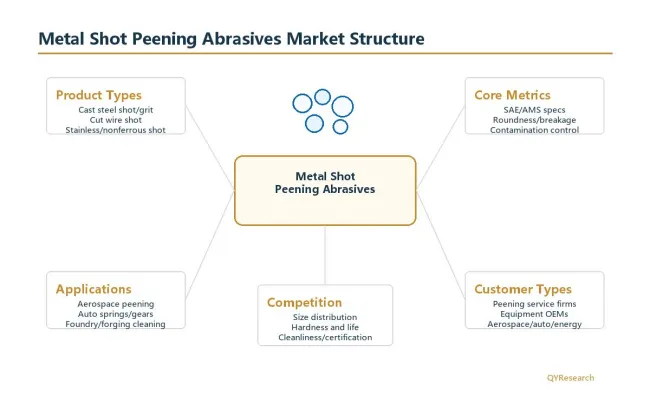
From a market structure perspective, metal shot peening abrasives are not ordinary consumables, but a surface-engineering material market composed of metal feedstock, chemistry control, forming process, heat treatment, screening and grading, quality inspection, equipment compatibility, and end-use process standards. By product type, the market can be divided into cast steel shot, steel grit, cut wire shot, conditioned cut wire shot, stainless steel shot, nonferrous metal shot, and specialty alloy media. By use, it covers shot peening, shot blasting, desanding, rust and scale removal, coating pretreatment, deburring, and surface profiling.
From the perspective of demand and competitive structure, metal shot peening abrasives mainly target shot peening service providers, blast and peening equipment manufacturers, aerospace supply chains, automotive component producers, spring and gear makers, foundries, forging plants, steel-structure and shipbuilding companies. Competition is moving beyond price per ton toward size distribution, hardness window, roundness, breakage rate, dust control, fatigue-life validation, certification documents, lot traceability, and technical service. For customers, media selection affects peening intensity, coverage, surface roughness, equipment wear, coating performance, and fatigue performance.
Figure2. Metal Shot Peening Abrasives Industry Chain
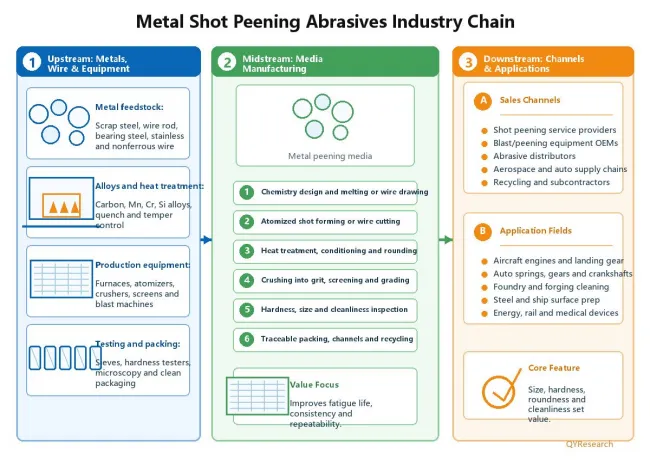
From the upstream perspective of the industry chain, basic inputs for metal shot peening abrasives include scrap steel, wire rod, bearing steel, stainless steel wire, zinc wire, aluminum wire, copper wire, alloying elements such as carbon, manganese, chromium and silicon, melting furnaces, atomization towers, wire drawing machines, cutting machines, crushers, screens, heat-treatment furnaces, conditioning equipment, hardness testers, size sieves, microscopy systems, and clean packaging materials. Feedstock purity and chemistry control determine hardness and toughness; heat treatment and conditioning determine media life; screening and inspection determine lot consistency.
From a midstream and downstream perspective, midstream value is concentrated in chemistry design, melting and atomization, wire cutting, heat treatment, conditioning and rounding, grit crushing, screening and grading, hardness testing, size inspection, cleanliness inspection, traceable packaging, and media recycling management. Downstream channels include shot peening service providers, blast and peening equipment OEMs, abrasive distributors, aerospace and automotive supply chains, foundries, forging companies, steel-structure and shipbuilding companies, and outsourced surface-treatment shops. Since metallic abrasives are recyclable consumables, customer stickiness comes from stable quality, consumption rate, and on-site process support.
Figure3. Working Principles of Metal Shot Peening Abrasives Based on Different Technical Approaches
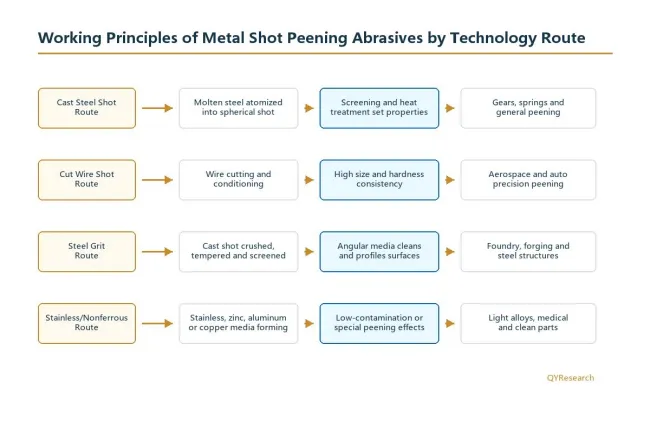
From a technical perspective, metal shot peening abrasives work by impacting the workpiece surface at high speed, creating local plastic deformation and residual compressive stress in the surface layer to improve fatigue life, stress-corrosion resistance, and surface consistency. The cast steel shot route uses melting, atomization, screening, and heat treatment to form spherical steel shot, suitable for general peening and blasting. The cut wire route uses wire cutting and conditioning to produce media with higher consistency in size, mass, and hardness, making it suitable for precision shot peening of aerospace parts, automotive springs, and gears.
The steel grit route crushes cast steel shot and then tempers and screens it into angular media, mainly used for desanding, rust removal, profiling, and coating pretreatment. Stainless steel and nonferrous metal media are used to avoid iron contamination, control surface residue, or treat light alloys and high-cleanliness components. Future metal shot peening abrasives will upgrade toward lower breakage, lower dust, higher cleanliness, ultra-fine sizes, traceable lots, compatibility with automated peening equipment, and recycling management, while high-end applications will place more emphasis on standards qualification, residual-stress validation, and full-process data.
Relevant Policies in China
From a policy perspective, metal shot peening abrasives are not usually listed as a standalone product name, but they are closely related to reliability improvement of industrial basic parts, green manufacturing, remanufacturing, surface engineering, quality improvement of aerospace and automotive components, industrial energy saving and carbon reduction, equipment renewal, and solid-waste resource utilization. China continues to promote high-end, intelligent, and green manufacturing, encourages quality upgrading of industrial basic materials and key components, and promotes green steel production, scrap-steel recycling, and cleaner industrial surface pretreatment. These policies support demand for high-end media, low-dust media, and recyclable consumables.
|
Policy Direction |
Timeframe |
Main Content |
Impact on the Metal Shot Peening Abrasive Industry |
|
Manufacturing Upgrading |
Long-term direction |
Promote high-end, intelligent and green manufacturing |
Benefits high-consistency and qualified metal peening media |
|
Industrial Basic-Part Reliability |
Since 2023 |
Improve quality and reliability of bearings, gears, springs and fasteners |
Expands shot peening and fatigue-life improvement demand |
|
Green Manufacturing System |
Ongoing |
Encourage cleaner production, energy saving, carbon reduction and recycling |
Promotes low-dust, recyclable and low-consumption metal media |
|
Green and Low-Carbon Steel |
Ongoing |
Promote scrap recycling, steel energy saving and ultra-low-emission upgrades |
Affects feedstock cost and supports recyclable consumables |
|
Large-Scale Equipment Renewal |
Since 2024 |
Support industrial equipment renewal, energy-saving upgrades and advanced manufacturing tools |
Drives automated blasting/peening equipment and premium media replacement |
|
Aerospace and High-End Equipment |
Long-term support |
Promote quality improvement in aerospace, energy equipment, rail and high-end machinery |
Raises demand for aerospace-grade cut wire, AMS shot and specialty media |
|
Remanufacturing and Circular Economy |
Ongoing |
Develop remanufacturing, repair and life-extension industries |
Increases media demand for peening, cleaning and surface restoration |
|
Environmental Inspection and Occupational Health |
Long-term implementation |
Strengthen dust, noise, solid-waste and workplace management |
Encourages low-dust, low-breakage and clean-packaged products |
|
Standards and Quality Systems |
Long-term implementation |
Strengthen standards, certification and quality traceability |
Raises requirements for size, hardness and lot traceability |
Growth drivers for the metal shot peening abrasive industry mainly include higher fatigue-life requirements for aerospace and automotive components, surface-treatment demand from construction machinery and wind/energy equipment, casting and forging cleaning, steel-structure coating pretreatment, outsourced shot peening service growth, adoption of automated blasting and peening equipment, customer requirements for repeatable processes and certification documents, and cost advantages from recyclable media. Challenges include steel price volatility, low-price homogeneous competition, dust and noise environmental constraints, long qualification cycles for high-end standards, complex peening process validation, media breakage control, and machine-wear management.
Industry Growth Trends, Barriers, and Challenges
|
Type |
Key Factor |
Specific Manifestation |
Impact on the Industry |
|
Growth Driver |
Aerospace and auto fatigue-life requirements |
Critical parts need residual compressive stress and surface strengthening |
Expands demand for premium cut wire, AMS steel shot and conditioned media |
|
Growth Driver |
Automated blasting and peening equipment |
Robotic peening, rotary-table peening and inline blasting increase |
Requires stable size, low breakage and low dust |
|
Growth Driver |
Casting, forging and steel surface treatment |
Desanding, rust removal, descaling and coating pretreatment remain steady |
Supports the base market for steel shot and grit |
|
Growth Driver |
Remanufacturing and repair growth |
Repair, strengthening and cleaning of parts increase |
Raises demand for recyclable media and peening services |
|
Growth Driver |
Customer qualification and traceability |
Aerospace and auto customers require lot documents and standards compliance |
Improves pricing power and customer stickiness for premium suppliers |
|
Growth Driver |
Low-dust and low-consumption trend |
Environmental and cost pressure support longer-life media |
Promotes low-breakage, clean packaging and recycling management products |
|
Barrier/Challenge |
Steel and alloy price volatility |
Scrap, wire, stainless steel and alloy element prices fluctuate |
Affects cost stability and quotation cycles |
|
Barrier/Challenge |
Low-price homogeneous competition |
Many ordinary steel shot and grit suppliers compete on price |
Compresses margins and limits quality-upgrade investment |
|
Barrier/Challenge |
Long high-end qualification cycle |
Aerospace and auto supply chains require testing, validation and audits |
Slows new entrants into premium customers |
|
Barrier/Challenge |
Complex peening process validation |
Intensity, coverage and residual stress are affected by many factors |
Requires process service and testing capabilities |
|
Barrier/Challenge |
Dust, noise and environmental constraints |
Breakage dust, noise and spent media disposal are regulated |
Promotes low-dust media and on-site recovery systems |
|
Barrier/Challenge |
Equipment wear and media breakage |
Hard media wear impellers, liners and nozzles |
Customers focus on life-cycle cost rather than unit price |
Overall, Metal Shot Peening Abrasives are moving from ordinary cleaning consumables toward high-consistency, long-life, traceable, and process-qualified surface-strengthening media. In the short term, automotive components, casting and forging, steel structures, and construction machinery will remain basic demand sources. In the medium and long term, aerospace, wind and energy equipment, rail transit, precision gears and springs, and remanufacturing will drive demand for premium cut wire shot, stainless steel shot, and specialty metallic media. Competition will shift from price-per-ton and capacity toward standards qualification, process service, life-cycle cost, and lot stability.
Metal Shot Peening Abrasives Report Chapter Summary:
Chapter 1: Metal Shot Peening Abrasives Industry Definition and Market Overview
This chapter clearly defines the product definition, characteristics, and industry statistical scope of Metal Shot Peening Abrasives, systematically introduces its mainstream product classifications and key application areas, and presents the overall size and future outlook of the global market.
Chapter 2: In-depth Analysis of Core Metal Shot Peening Abrasives Companies (2021-2025)
This chapter focuses on the main players in the Metal Shot Peening Abrasives market. For each representative company, it not only introduces its basic overview, main business, and product portfolio, but also highlights its core operating data in the Metal Shot Peening Abrasives field, including sales volume, sales revenue, pricing strategies, and the latest development trends of the company from 2021 to 2025.
Chapter 3: Global Competitive Landscape Analysis (2021-2025)
This chapter examines the global Metal Shot Peening Abrasives competitive landscape from a macro perspective. By comparing the Metal Shot Peening Abrasives sales volume, pricing, revenue, and market share of major companies from 2021 to 2025, it quantitatively analyzes market concentration and interprets the competitive strategies and market position evolution of core manufacturers.
Chapter 4: Metal Shot Peening Abrasives Major Regional Market Size and Prospects (2021-2032)
This chapter conducts a regional-level analysis of the global Metal Shot Peening Abrasives core markets. It will present historical data on the Metal Shot Peening Abrasives market size (sales volume and revenue from 2021-2025) in major regions such as North America, Europe, and Asia Pacific, and provide market outlook forecasts for 2026-2032.
Chapter 5: Metal Shot Peening Abrasives Product Type Segmentation Market Forecast (2021-2032)
This chapter delves into the Metal Shot Peening Abrasives product structure. It will segment the Metal Shot Peening Abrasives market by different types (such as Steel、Copper、Zinc、Others, etc.), and analyze in detail the historical market size of each segmented product category from 2021 to 2025 and the future growth trends from 2026 to 2032.
Chapter 6: Metal Shot Peening Abrasives Application Field Segmentation Market Forecast (2021-2032)
This chapter delves into the downstream application demand for Metal Shot Peening Abrasives. The market will be segmented by different application areas (such as Shipbuilding、Automobile、Engineering Machinery、Others, etc.), presenting the historical market size for each area from 2021-2025 and future demand forecasts from 2026-2032.
Chapters 7-11: In-depth Analysis of Global Regional Markets (2021-2032)
This section is the core module of the Metal Shot Peening Abrasives report, providing an in-depth country/regional analysis across five major regions: North America, Europe, Asia Pacific, South America, and the Middle East & Africa. The chapter structure for each region is consistent:
Segmentation by Country/Region: Analysis of the market size and forecasts for major countries within the region from 2021-2032.
Segmentation by Product Type: Presentation of the market structure and development forecasts for different product types within the region from 2021-2032.
Segmentation by Application Area: Analysis of market demand and prospects for different application areas within the region from 2021-2032.
Chapter 12: Global Metal Shot Peening Abrasives Market Dynamics, Challenges, and Trends
This chapter aims to analyze the key internal and external factors affecting the development of the Metal Shot Peening Abrasives market. It systematically reviews the core drivers of Metal Shot Peening Abrasives market growth, the main obstacles and challenges faced, and assesses future product, technology, and market development trends.
Chapter 13: Metal Shot Peening Abrasives Industry Chain Structure Analysis
This chapter analyzes the entire industry chain ecosystem of the Metal Shot Peening Abrasives industry. From upstream raw material supply to midstream production and manufacturing, and then to downstream end-use applications, it analyzes the current status, cost structure, and collaborative relationships of each link.
Chapter 14: Sales Channel Model Research
This chapter focuses on the distribution channels of Metal Shot Peening Abrasives products. It analyzes the market share, advantages and disadvantages, and typical cases of mainstream sales channels, and explores the innovation and development trends of channel models.
Chapter 15: Research Conclusions and Strategic Recommendations
As a summary of the report, this chapter will distill the core findings and conclusions of the entire report and, based on a comprehensive understanding of the Metal Shot Peening Abrasives market, provide actionable strategic development recommendations for industry participants and potential entrants.
For more information, please refer to "Global Metal Shot Peening Abrasives Market 2026 by Manufacturers, Regions, Type and Application, Forecast to 2032". This report analyzes the supply and demand situation, development status, and changes in the industry, focusing on the development status of the industry, how to face the development challenges of the industry, industry development suggestions, industry competitiveness, and industry investment analysis and trend forecasts. The report also summarizes the overall development dynamics of the industry, including the impact of the latest US tariffs on the global supply chain, the supply relationship analysis of the industrial chain, and provides reference suggestions and specific solutions for the industry in terms of products.
Previous News:
2026 Market Analysis Report: Global All-in-one Inverter Market Valued at US$14,205 Million in 2026, Projected to Reach US$21,309 Million by 2032 at 7.0% CAGR
Next News:
2026 Market Analysis Report: Global Key Blank Market Valued at US$1,192 Million in 2026, Projected to Reach US$1,630 Million by 2032 at 5.4% CAGR
The copyright of this article belongs to Global Info Research. Without the written authorization of our company, no organization or individual may reprint, quote, copy, adapt or use it for commercial purposes in any way. When authorized to use, the original source must be indicated as "Global Info Research" and the complete copyright information must be retained.
- We Provide Professional, Accurate Market Analysis to Help You Stay Ahead of Your Competition.Speak to our analyst >>

Our Clients
What We Can Provide?
With better results and higher quality products,Our professional reports can achieve four things:

Insight into the industry market information

Analyze market development needs

Prospects for future development

Develop industry investment strategy
- Digging deeper into global industry information and providing market strategies.Contact Us >>
- We Provide Professional, Accurate Market Analysis to Help You Stay Ahead of Your Competition.Speak to our analyst >>
Our Clients
What We Can Provide?
With better results and higher quality products,Our professional reports can achieve four things:
Insight into the industry market information
Analyze market development needs
Prospects for future development
Develop industry investment strategy
- Digging deeper into global industry information and providing market strategies.Contact Us >>