
Global Governed Enterprise Architecture Scenario Sandbox Market Is Projected to Reach USD 1,963 Million by 2032, Expanding at a 15.3% CAGR During the 2026–2032 Forecast Period
Published Date: Monday,09 Nov,2026


 Governed Enterprise Architecture Scenario Sandbox
Governed enterprise architecture scenario sandbox refers to a class of software platforms and related services that enable organizations to create isolated, permission-aware copies of their enterprise architecture for modeling future states, comparing design options, simulating transition paths, and exposing architecture context to AI assistants without altering the production baseline. The core value of these platforms lies in addressing a long-standing tension in enterprise architecture management: the need to conduct what-if analysis for strategic decision-making while maintaining the stability, authority, and security of production architecture data.
From a functional architecture perspective, governed enterprise architecture scenario sandboxes typically include several core modules. Repository branching and version management allows architects to create independent branches from the baseline architecture repository, freely modifying models, adding or removing elements, and adjusting relationships without affecting the authoritative architecture data in the main repository. Scenario modeling and option comparison provides a visual environment for designing multiple alternative target architecture schemes and comparing them across a unified evaluation framework. Transition path planning and impact analysis designs phased migration paths between current and target architectures, identifying systems, interfaces, and business processes that may be affected at each stage. Governance controls and permission management ensure that all operations within the sandbox are subject to role-based access controls, with any data write-back from the sandbox to the baseline repository requiring review and approval. Additionally, AI-compatible access patterns are a distinctive feature, exposing structured architecture context to AI agents via standardized APIs while limiting AI operational scope and data visibility through permission sandbox mechanisms.
Global Governed Enterprise Architecture Scenario Sandbox Market Size (US$ Million), 2021-2032
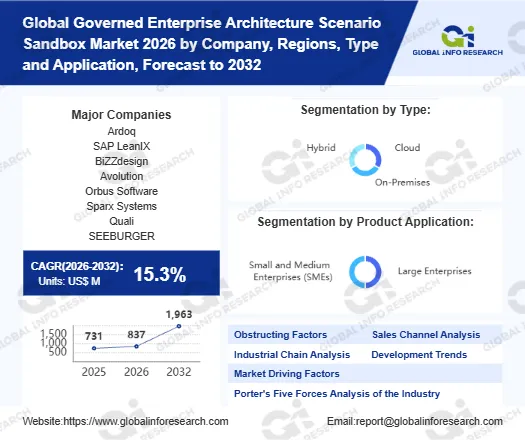
According to the latest report "Global Governed Enterprise Architecture Scenario Sandbox Market 2026 by Manufacturers, Regions, Type and Application, Forecast to 2032"published by GIR (Global Info Research), the global Governed Enterprise Architecture Scenario Sandbox market was valued at approximately USD 731 million in 2025 and is projected to reach USD 837 million in 2026. With a CAGR of 15.3% during the forecast period from 2026 to 2032, the market is expected to further expand to approximately USD 1963 million by 2032. This growth is driven by increasing market demand, evolving industry trends, and expanding application opportunities worldwide.
Governed Enterprise Architecture Scenario Sandbox Industrial Chain
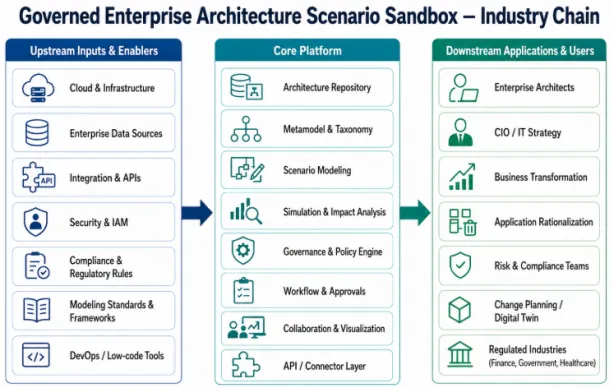
Industry Chain Analysis
Upstream segment: enterprise system data sources and integration service providers.
The upstream segment primarily includes enterprise system integration service providers and data connector vendors that supply foundational data to enterprise architecture repositories. These upstream participants focus on establishing data pipelines between the architecture sandbox platform and various source systems. The technical challenge lies in handling different systems' data models, interface protocol diversity, and real-time data update requirements. Upstream enterprises that offer extensive pre-built connector libraries and flexible data mapping solutions possess stronger bargaining power.
Midstream segment: enterprise architecture sandbox platform developers and solution providers.
The midstream segment represents the core value link of the industry chain, consisting of various enterprise architecture software developers and solution providers. This includes established enterprise architecture tool vendors extending toward sandbox capabilities, as well as platforms that integrate architecture decisions, AI assistance, and agent modeling within a unified environment. Core competencies of midstream enterprises include sandbox environment isolation security, branch and merge reliability, scenario comparison framework robustness, and ease of AI system integration. Midstream players also need to provide supporting implementation and advisory services to help customers embed sandbox platforms into existing architecture governance processes.
Downstream segment: large enterprises and industry users.
The downstream segment consists of end-users of governed enterprise architecture scenario sandbox platforms, primarily large enterprises—a customer structure that reflects the platform's higher requirements for organizational scale, architectural complexity, and governance maturity. Typical application scenarios include comparing different technology roadmap choices in digital transformation programs, simulating the integration of two enterprise architectures in merger and acquisition contexts, designing phased migration paths for cloud migration projects, and providing safe experimental environments for AI agents when AI-assisted architecture planning is deployed.
Value distribution and future trends.
From a value distribution perspective, midstream platform developers mastering core sandbox isolation technology and scenario modeling frameworks capture the highest value-added. Upstream data integration services, while necessary, tend toward commoditization as pre-built connector libraries expand and standardized interfaces become prevalent.
Future industry chain evolution may exhibit several directions. First, AI integration is becoming a key battleground for platform differentiation, with platforms capable of providing governed, auditable AI agent access gaining competitive advantages. Second, horizontal expansion into adjacent governance domains is increasingly evident. Third, deepening cloud-native deployment models are transforming delivery methods and value distribution. Fourth, increasing demand for sandbox platform integration with agile delivery processes and CI/CD pipelines is driving horizontal alignment across the industry chain.
Global Governed Enterprise Architecture Scenario Sandbox Top 19 Players Ranking and Market Share (Ranking is based on the revenue of 2025, continually updated)
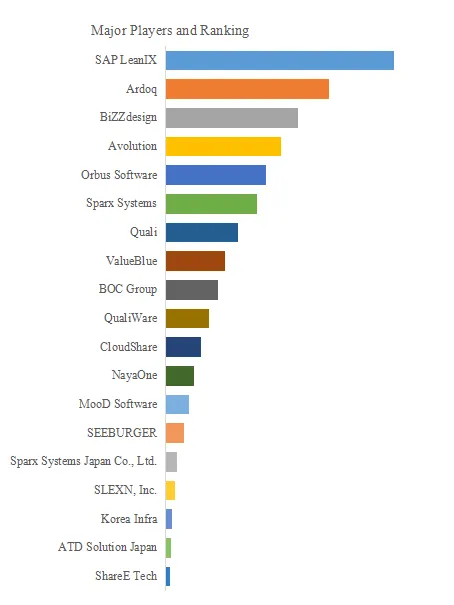
Overall Industry Development
The global governed enterprise architecture scenario sandbox market is in a high-growth early expansion phase. This market's emergence results from multiple converging factors: significantly increased requirements for architecture planning quality as digital transformation enters advanced stages, sharply rising demand for controlled experimentation environments as AI technology enters enterprise core systems, and long-standing functional gaps in traditional enterprise architecture tools for supporting what-if analysis and scenario comparison. From a market size perspective, the market continues to maintain a strong compound annual growth rate over the forecast period.
From an industry development stage perspective, the market is transitioning from supporting function to core capability positioning. Early on, scenario sandbox features typically existed as附属 modules within enterprise architecture suites. As digital transformation program complexity increases and AI-assisted planning becomes more prevalent, architecture teams have recognized the need for dedicated, standalone sandbox environments—rather than scattered whiteboards and spreadsheets—to systematically manage future-state design, option comparison, and transition path planning. AI involvement further reinforces this trend: when architecture data becomes planning input for AI assistants, deploying architecture AI without sandbox environments for experiment isolation, permission control, and behavior auditing would face high security risks.
From a regional perspective, adoption speeds vary significantly across major markets. North America leads in market size and product innovation, benefiting from higher enterprise architecture maturity, earlier AI application deployment, and the presence of multiple leading platform vendors. Europe follows closely, particularly in financial services, manufacturing, and public sectors where architecture governance requirements are stringent. The Asia-Pacific region is considered the highest growth-potential area, with this growth driven by rapid digital transformation acceleration, increasingly complex enterprise architecture environments, and gradually strengthening architecture governance awareness.
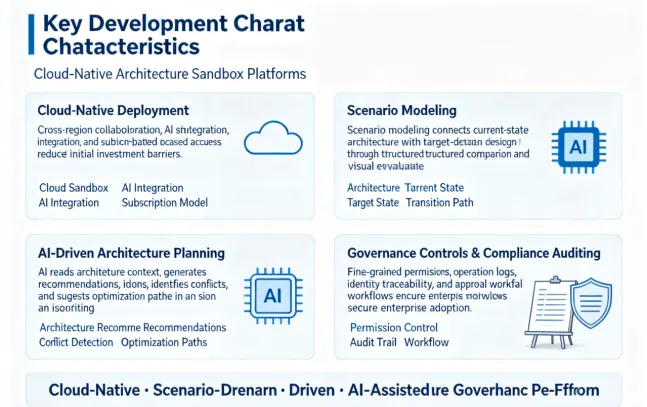
Key Development Characteristics
Characteristic One: Cloud-Native Deployment Becoming the Dominant Model, Accelerating AI Integration and Collaborative Workflows.
From a deployment perspective, cloud-based sandbox platforms have captured the majority market share. Cloud deployment offers superior value propositions across multiple dimensions. First, cloud platforms naturally support cross-region, cross-department collaborative workflows. Second, cloud platform integration with AI services is more convenient. Third, cloud deployment lowers initial investment thresholds, allowing enterprises to pay via subscription rather than large upfront software licensing and hardware procurement costs.
Characteristic Two: Scenario Modeling Becoming the Core Functional Module, Reflecting Strong Demand for Systematic Future-State Design.
Among various governed enterprise architecture scenario sandbox functions, scenario modeling platforms account for a significant share of product revenue. This reflects a common pain point in architecture team practice: traditional architecture tools excel at recording current state and defining target state but fall short in connecting the two with transition path design and multi-option comparison. Dedicated scenario modeling functionality solves this through structured approaches, providing unified comparison frameworks, quantifiable evaluation metrics, and visual result presentation.
Characteristic Three: AI-Driven Architecture Planning Reshaping Sandbox Platform Value Proposition.
AI is fundamentally changing enterprise architecture planning workflows, with governed sandboxes playing a critical role in this transformation. On one hand, AI can read architecture context information from sandboxes and generate architecture recommendations, identify potential conflicts, or recommend optimization paths based on this information. On the other hand, because enterprise architecture data is highly sensitive—revealing IT assets, business capabilities, and strategic priorities—directly exposing AI agents to production environment data carries high risks. Sandboxes provide an ideal compromise, allowing AI to access authorized architecture data and execute planning tasks in an isolated environment with all operations logged, traceable, and auditable.
Characteristic Four: Governance Controls and Compliance Auditing Becoming Core Considerations for Enterprise Sandbox Platform Adoption.
For large enterprises—particularly those in regulated industries—any access to or modification of architecture data must operate under strict governance frameworks. Governed sandbox platforms meet this need through built-in permission management, operation auditing, and approval workflows. Unlike shared whiteboard approaches where any participant can arbitrarily modify content without traceability, sandbox platforms provide fine-grained permission controls, with all modifications carrying operator identity and timestamps, fully traceable. When designs are fully validated and ready for write-back to production architecture repositories, the platform triggers approval workflows, ensuring every baseline change undergoes appropriate review.
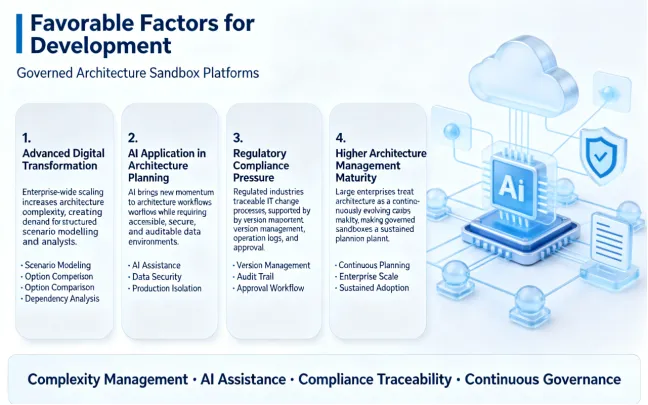
Favorable Factors for Development
First, digital transformation reaching advanced stages significantly raises architecture planning quality requirements.
As digital transformation progresses from pilot phases to organization-wide, full-business-coverage scaled implementation, enterprise architecture planning complexity increases exponentially. Governed sandbox platforms address this growing complexity management need through structured scenario modeling, systematic option comparison, and visualized dependency impact analysis.
Second, the AI application wave in enterprise architecture planning injects strong growth momentum into the sandbox market.
Artificial intelligence is gradually permeating every aspect of enterprise architecture workflows. However, deploying these AI capabilities places new demands on the accessibility, security, and auditability of architectural data. Sandbox environments address these requirements by providing controlled, auditable, and production-isolated spaces for experimentation.
Third, regulatory compliance pressure drives continuously increasing traceability requirements for architecture change processes.
In regulated industries, IT system change management must maintain traceability and proper authorization. Governed sandbox platforms, through built-in version management, operation logs, and approval workflows, naturally satisfy these traceability requirements, providing strong support for passing compliance audits.
Fourth, increasing architecture management maturity in large enterprises creates sustained sandbox adoption demand.
As enterprise architecture practice matures, large enterprises recognize that architecture is not a one-time blueprint but a continuously evolving entity. This continuous planning work pattern is exactly the core application scenario for governed sandboxes. Large enterprises account for the majority of demand share, confirming the positive correlation between sandbox platforms and organizational scale.
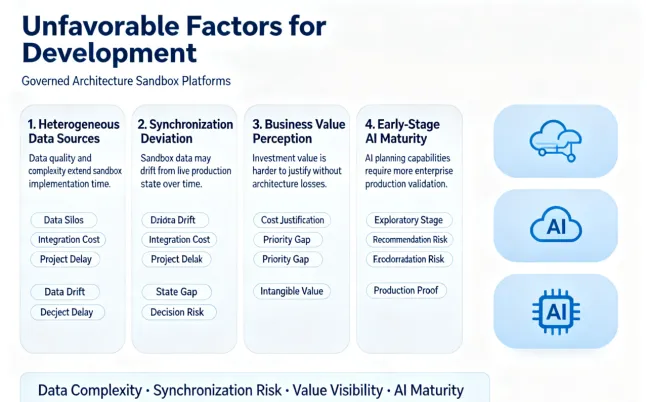
Unfavorable Factors for Development
First, heterogeneity and variable quality of enterprise architecture data sources increase sandbox implementation complexity.
Governed enterprise architecture sandbox value highly depends on input data accuracy and completeness. In reality, enterprise architecture data is often scattered across multiple heterogeneous systems with inconsistent data models, different update frequencies, and variable quality. Sandbox projects often require lengthy data cleansing and alignment phases before going live, frequently exceeding expectations and causing delays or cost overruns.
Second, synchronization deviation between sandbox and production environments may weaken architecture planning decision value.
Sandbox value derives from planning future states based on current architecture state. However, enterprise architecture is dynamic—systems in production are continuously upgraded, decommissioned, migrated, with evolving dependencies. After prolonged runtime, a sandbox branch may deviate from ground truth. If architects base planning decisions on such deviated data, resulting solutions may require significant adjustments during implementation.
Third, the business value of sandbox platforms remains challenging for some enterprises to perceive.
For enterprises that have not experienced significant losses due to poor architecture planning, the value of governed sandbox platforms may not be intuitive. Whether investment in a sandbox platform is justified depends on architecture complexity, transformation program scale, and internal governance stringency.
Fourth, AI-assisted architecture planning technology maturity remains in early stages, with real-world effectiveness yet to be validated.
Although AI application prospects in enterprise architecture are widely optimistic, this field remains exploratory. Large language model performance in specialized domains like enterprise architecture—accuracy of generated architecture recommendations, depth of dependency understanding, and hallucination avoidance—has not yet been fully validated through large-scale production environments.
Entry Barriers
First, deep integration capability with enterprise architecture data sources constitutes a technical access barrier.
Governed enterprise architecture sandbox value largely depends on how well and how quickly it can access real enterprise architecture data. This requires connectivity with multiple heterogeneous data sources. Developing a pre-built connector library covering common source systems requires substantial engineering investment and ongoing maintenance. New entrants lacking this deep integration capability will struggle to achieve rapid customer deployment.
Second, scenario modeling and option comparison framework design complexity creates product barriers.
While conceptually simple, the core functions involve complex engineering decisions about evaluation dimensions, weighting, visualization, and objectivity. Answers to these questions lack universal standards
but must be iteratively refined through extensive customer practice. First-movers have established mature modeling methodologies and comparison frameworks through client project accumulation, constituting product-level core competencies.
Third, branch and merge reliability faces technical challenges at enterprise architecture scale.
While branch and merge mechanisms are relatively simple at small scale, when enterprise architecture repositories contain thousands of elements with complex dependencies, merge conflicts become difficult to avoid. Designing efficient conflict detection, difference presentation, and merge assistance mechanisms presents significant engineering challenges.
Fourth, customer requirements for architecture governance maturity create market and sales barriers.
The primary user base consists of large enterprises with relatively mature enterprise architecture practices. Such customers evaluate not only product features but also suppliers' understanding of architecture governance processes, industry best practice references, and experience supporting large complex project implementation. Gaining trust from these customers is difficult for new entrants without extensive industry experience. Additionally, large enterprise procurement cycles are long, involving multiple evaluation rounds, demanding strong sales capabilities and customer relationship management.
Governed Enterprise Architecture Scenario Sandbox Report Chapter Summary:
Chapter 1: Governed Enterprise Architecture Scenario Sandbox Industry Definition and Market Overview
This chapter clearly defines the product definition, characteristics, and industry statistical scope of Governed Enterprise Architecture Scenario Sandbox, systematically introduces its mainstream product classifications and key application areas, and presents the overall size and future outlook of the global market.
Chapter 2: In-depth Analysis of Core Governed Enterprise Architecture Scenario Sandbox Companies (2021-2025)
This chapter focuses on the main players in the Governed Enterprise Architecture Scenario Sandbox market. For each representative company, it not only introduces its basic overview, main business, and product portfolio, but also highlights its core operating data in the Governed Enterprise Architecture Scenario Sandbox field, including sales volume, sales revenue, pricing strategies, and the latest development trends of the company from 2021 to 2025.
Chapter 3: Global Competitive Landscape Analysis (2021-2025)
This chapter examines the global Governed Enterprise Architecture Scenario Sandbox competitive landscape from a macro perspective. By comparing the Governed Enterprise Architecture Scenario Sandbox sales volume, pricing, revenue, and market share of major companies from 2021 to 2025, it quantitatively analyzes market concentration and interprets the competitive strategies and market position evolution of core manufacturers.
Chapter 4: Governed Enterprise Architecture Scenario Sandbox Major Regional Market Size and Prospects (2021-2032)
This chapter conducts a regional-level analysis of the global Governed Enterprise Architecture Scenario Sandbox core markets. It will present historical data on the Governed Enterprise Architecture Scenario Sandbox market size (sales volume and revenue from 2021-2025) in major regions such as North America, Europe, and Asia Pacific, and provide market outlook forecasts for 2026-2032.
Chapter 5: Governed Enterprise Architecture Scenario Sandbox Product Type Segmentation Market Forecast (2021-2032)
This chapter delves into the Governed Enterprise Architecture Scenario Sandbox product structure. It will segment the Governed Enterprise Architecture Scenario Sandbox market by different types (such as Cloud、On-Premises、Hybrid, etc.), and analyze in detail the historical market size of each segmented product category from 2021 to 2025 and the future growth trends from 2026 to 2032.
Chapter 6: Governed Enterprise Architecture Scenario Sandbox Application Field Segmentation Market Forecast (2021-2032)
This chapter delves into the downstream application demand for Governed Enterprise Architecture Scenario Sandbox. The market will be segmented by different application areas (such as Large Enterprises、Small and Medium Enterprises (SMEs), etc.), presenting the historical market size for each area from 2021-2025 and future demand forecasts from 2026-2032.
Chapters 7-11: In-depth Analysis of Global Regional Markets (2021-2032)
This section is the core module of the Governed Enterprise Architecture Scenario Sandbox report, providing an in-depth country/regional analysis across five major regions: North America, Europe, Asia Pacific, South America, and the Middle East & Africa. The chapter structure for each region is consistent:
Segmentation by Country/Region: Analysis of the market size and forecasts for major countries within the region from 2021-2032.
Segmentation by Product Type: Presentation of the market structure and development forecasts for different product types within the region from 2021-2032.
Segmentation by Application Area: Analysis of market demand and prospects for different application areas within the region from 2021-2032.
Chapter 12: Global Governed Enterprise Architecture Scenario Sandbox Market Dynamics, Challenges, and Trends
This chapter aims to analyze the key internal and external factors affecting the development of the Governed Enterprise Architecture Scenario Sandbox market. It systematically reviews the core drivers of Governed Enterprise Architecture Scenario Sandbox market growth, the main obstacles and challenges faced, and assesses future product, technology, and market development trends.
Chapter 13: Governed Enterprise Architecture Scenario Sandbox Industry Chain Structure Analysis
This chapter analyzes the entire industry chain ecosystem of the Governed Enterprise Architecture Scenario Sandbox industry. From upstream raw material supply to midstream production and manufacturing, and then to downstream end-use applications, it analyzes the current status, cost structure, and collaborative relationships of each link.
Chapter 14: Sales Channel Model Research
This chapter focuses on the distribution channels of Governed Enterprise Architecture Scenario Sandbox products. It analyzes the market share, advantages and disadvantages, and typical cases of mainstream sales channels, and explores the innovation and development trends of channel models.
Chapter 15: Research Conclusions and Strategic Recommendations
As a summary of the report, this chapter will distill the core findings and conclusions of the entire report and, based on a comprehensive understanding of the Governed Enterprise Architecture Scenario Sandbox market, provide actionable strategic development recommendations for industry participants and potential entrants.
For more information, please refer to "Global Governed Enterprise Architecture Scenario Sandbox Market 2026 by Manufacturers, Regions, Type and Application, Forecast to 2032". This report analyzes the supply and demand situation, development status, and changes in the industry, focusing on the development status of the industry, how to face the development challenges of the industry, industry development suggestions, industry competitiveness, and industry investment analysis and trend forecasts. The report also summarizes the overall development dynamics of the industry, including the impact of the latest US tariffs on the global supply chain, the supply relationship analysis of the industrial chain, and provides reference suggestions and specific solutions for the industry in terms of products.
Previous News:
From Stacker Cranes to AMR fleets: Intelligent Automated Storage and Retrieval System Market Enters 2026 at 7.9% CAGR, Targeting USD 32,631 Million by 2032
Next News:
The copyright of this article belongs to Global Info Research. Without the written authorization of our company, no organization or individual may reprint, quote, copy, adapt or use it for commercial purposes in any way. When authorized to use, the original source must be indicated as "Global Info Research" and the complete copyright information must be retained.
- We Provide Professional, Accurate Market Analysis to Help You Stay Ahead of Your Competition.Speak to our analyst >>

Our Clients
What We Can Provide?
With better results and higher quality products,Our professional reports can achieve four things:

Insight into the industry market information

Analyze market development needs

Prospects for future development

Develop industry investment strategy
- Digging deeper into global industry information and providing market strategies.Contact Us >>
- We Provide Professional, Accurate Market Analysis to Help You Stay Ahead of Your Competition.Speak to our analyst >>
Our Clients
What We Can Provide?
With better results and higher quality products,Our professional reports can achieve four things:
Insight into the industry market information
Analyze market development needs
Prospects for future development
Develop industry investment strategy
- Digging deeper into global industry information and providing market strategies.Contact Us >>