
NCM and NCA Precursor Material Market 2026: A 6.9% CAGR Points to a USD 37,682 Million Opportunity by 2032 as EV Demand and High-Nickel Routes Deepen
Published Date: Wednesday,18 Nov,2026


 NCM and NCA Precursor Material
 Market Summary
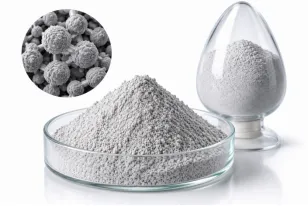
NCM/NCA ternary precursor refers to the hydroxide co precipitated compound of nickel, cobalt, aluminum (or manganese), which can be expressed as NixCoyMn (1-x-y) (OH) ₂ (NCM) or NixCoyAl (1-x-y) (OH) ₂ (NCA). It is a key intermediate for the production of nickel cobalt manganese oxide/nickel cobalt aluminum oxide ternary cathode materials.
From the perspective of industrial status, the value of precursors can account for more than half of the value of ternary positive electrode materials, and the proportion of positive electrode materials in the cost of lithium battery materials is as high as about 40%. More importantly, ternary cathode materials have good "inheritance" from precursors - core indicators such as particle size distribution, tap density, and elemental molar ratio of precursors will directly determine the electrochemical performance of the final cathode material.
Against the backdrop of continuous expansion of the global power battery industry and accelerated penetration of high nickel technology routes, NCM (nickel cobalt manganese) and NCA (nickel cobalt aluminum) ternary precursor materials, as the "core skeleton" of lithium-ion battery cathodes, are ushering in a new development cycle.
Global NCM and NCA Precursor Material Market Size (US$ Million), 2021-2032
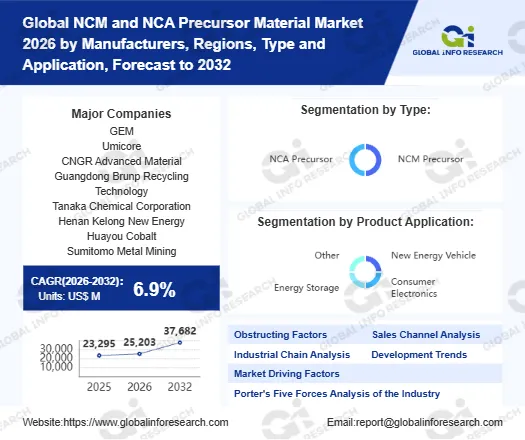
According to the latest report published "Global NCM and NCA Precursor Material Market 2026 by Manufacturers, Regions, Type and Application, Forecast to 2032" by GIR (Global Info Research), the global NCM and NCA Precursor Material market was valued at approximately USD 23295 million in 2025 and is projected to reach USD 25203 million in 2026. With a CAGR of 6.9% during the forecast period from 2026 to 2032, the market is expected to further expand to approximately USD 37682 million by 2032. This growth is driven by increasing market demand, evolving industry trends, and expanding application opportunities worldwide.
Figure00001. Global NCM and NCA Precursor Material Top 19 Players Ranking and Market Share (Ranking is based on the revenue of 2025, continually updated)
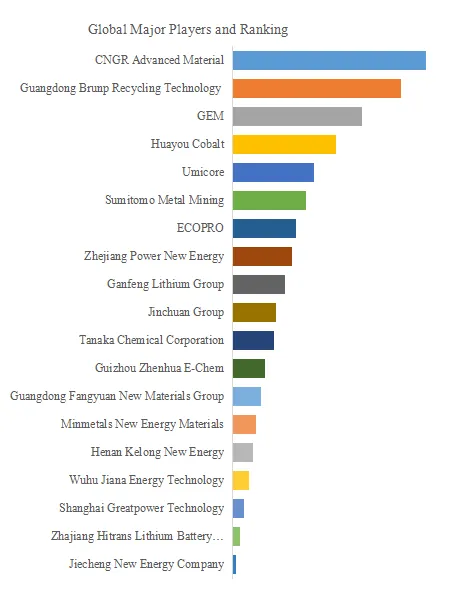
According to Global Info Research Top Players Research Center, the global key manufacturers of High Purity Basic Copper Carbonate include CNGR Advanced Material, Guangdong Brunp Recycling Technology , GEM, Huayou Cobalt, Umicore, Sumitomo Metal Mining, ECOPRO, Zhejiang Power New Energy, Ganfeng Lithium Group, Jinchuan Group, etc. In 2025, the global top 10 players had a share approximately 72.0% in terms of revenue.
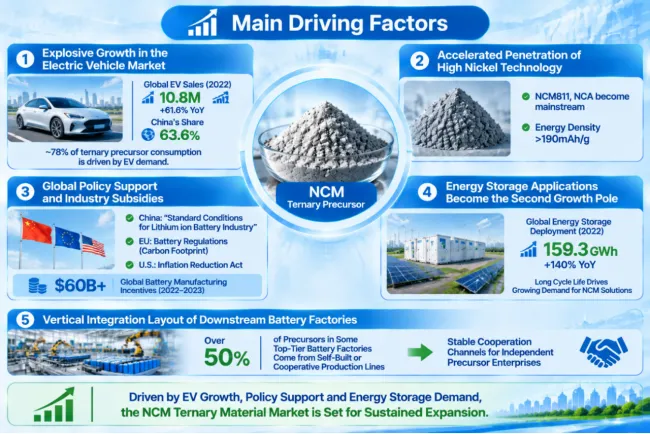
Main driving factors
1. Explosive growth in the electric vehicle market
Global electric vehicle sales continue to rise, with global EV sales exceeding 10.8 million units in 2022, a year-on-year increase of 61.6%. As the world's largest market, China's EV sales reached 6.8 million units in 2022, accounting for 63.6% of the global market share. As a key material for the positive electrode of power batteries, ternary precursors directly benefit from the expansion of the EV market - nearly 78% of ternary precursor material consumption is affected by the demand for electric vehicles.
2. Accelerated penetration of high nickel technology route
To meet consumers' demand for longer range, battery companies are accelerating their upgrade towards high nickel (NCM811, NCA). The high nickel ternary material has significant advantages in energy density, and the actual gram capacity of NCM811 can exceed 190mAh/g. This trend drives precursor companies to transform towards products with higher nickel content, and also puts forward higher requirements for the production process of precursors.
3. Global policy support and industry subsidies
The new energy vehicle industry policies of governments around the world continue to create favorable conditions for the upstream materials industry
China's' Standard Conditions for Lithium ion Battery Industry 'sets quality standards for the industry
EU battery regulations require strict carbon footprint reporting standards
The localization requirements of the US Inflation Reduction Act are driving battery manufacturers to establish local precursor supply chains
Between 2022 and 2023, the total value of battery manufacturing incentives announced globally will exceed $60 billion, with a significant portion going towards the construction of positive electrode material supply chains.
4. Energy storage applications become the second growth pole
In addition to automotive applications, grid level energy storage systems are becoming a rapidly growing market for ternary materials. In 2022, the global deployment of lithium-ion energy storage reached 159.3 GWh, a year-on-year increase of 140%. The ternary based energy storage solution has gained market favor due to its long cycle life.
5. Vertical integration layout of downstream battery factories
Leading battery companies are accelerating their expansion into the upstream precursor field, locking in production capacity through joint ventures or technology licensing. At present, more than 50% of the precursors in some first-line battery factories come from self built or cooperative production lines, which creates a stable cooperation channel for independent precursor enterprises with mature technology.
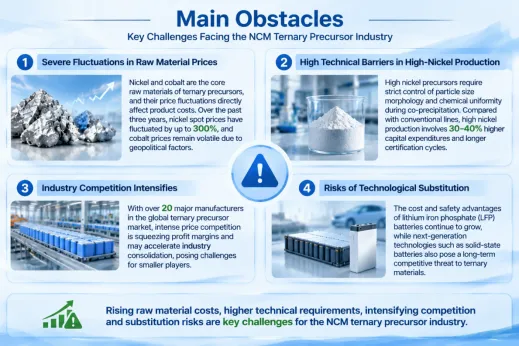
Main obstacles
1. Severe fluctuations in raw material prices
Nickel and cobalt are the core raw materials of ternary precursors, and their price fluctuations directly affect product costs. Over the past three years, nickel spot prices have fluctuated by up to 300%, and cobalt prices have also been continuously affected by geopolitical factors in the African supply chain. This price instability increases the difficulty of long-term pricing and inventory management for enterprises.
2. High technical barriers in the production of high nickel precursors
With the development of the industry towards high nickel, the technological challenges faced by precursor production have significantly increased. The high nickel precursor has extremely strict requirements for particle size morphology control and chemical uniformity during co precipitation, and process parameters become more sensitive with increasing nickel content. Compared to conventional precursor production lines, high nickel production lines have 30-40% higher capital expenditures and longer certification cycles.
3. Industry competition intensifies, squeezing profit margins
There are over 20 major manufacturers competing in the global ternary precursor market. Chinese manufacturers dominate with their pricing strategies, but intense price competition also brings profit pressure to the entire industry. This trend may accelerate industry consolidation, and smaller participants face survival challenges.
4. Risks of technological substitution
The cost and safety advantages of lithium iron phosphate (LFP) batteries continue to increase, creating certain substitution pressure for ternary batteries in the mid to low end vehicle market. In addition, the development of next-generation technologies such as solid-state batteries also poses a long-term competitive threat to ternary materials.
Industry development opportunities
1. Building long-term competitiveness through overseas production capacity layout
Faced with the cancellation of export tax rebates and the increase of trade barriers, building factories overseas has become an important trend in the industry. The production capacity layout in Indonesia, Europe, South Korea and other places is accelerating, and companies can use this approach to:
Close to the target market and reduce logistics costs
Avoiding trade barriers and tariff risks
Enhance delivery responsiveness to overseas customers
For enterprises with financial strength and strategic ambition, overseas production capacity layout will become one of the key variables determining global competitiveness.
2. The development of next-generation precursor technology brings differentiation opportunities
Advanced precursor engineering technology has created significant potential for value creation:
Advanced doping technology: Incorporating aluminum, magnesium, or zirconium elements into NCM precursors can improve cathode thermal stability without sacrificing energy density
Single crystal precursor particles: Single crystal particles provide better cycle life in high-pressure applications, representing another promising development direction
Ultra high nickel (Ni ≥ 90%) precursor: meets the performance requirements of the next generation of long-range batteries
Technological innovation oriented enterprises can obtain price premiums and long-term supply agreements through these differentiated products.
3. Green and low-carbon manufacturing have become new dimensions of competition
Environmental factors are becoming a key procurement criterion in the battery supply chain. Precursor companies that adopt green manufacturing processes such as water circulation systems and renewable energy supply gain a competitive advantage among customers who prioritize sustainable development. Research predicts that the low-carbon footprint precursor market may grow to 40% of total demand by 2030, creating strong incentives for early adopters of clean production technologies.
4. Recycling and circular economy building a closed-loop ecosystem
The tight supply of key raw materials such as nickel and cobalt has made recycling and utilization an important direction for the industry. Extracting valuable metals through the recycling of waste batteries can effectively reduce dependence on mineral resources and the risk of cost fluctuations. Precursor companies with recycling capabilities will gain advantages in supply chain security.
5. NCM will continue to dominate, while NCA will continue to penetrate
According to market data, NCM precursors account for over 60% of the market share, and their balanced performance and cost combination make them an ideal choice for electric vehicles and energy storage systems. NCA materials maintain their strong position in the high-end market, especially in applications for top customers such as Tesla, thanks to their excellent energy density.
NCM and NCA Precursor Material Report Chapter Summary:
Chapter 1: NCM and NCA Precursor Material Industry Definition and Market Overview
This chapter clearly defines the product definition, characteristics, and industry statistical scope of NCM and NCA Precursor Material, systematically introduces its mainstream product classifications and key application areas, and presents the overall size and future outlook of the global market.
Chapter 2: In-depth Analysis of Core NCM and NCA Precursor Material Companies (2021-2025)
This chapter focuses on the main players in the NCM and NCA Precursor Material market. For each representative company, it not only introduces its basic overview, main business, and product portfolio, but also highlights its core operating data in the NCM and NCA Precursor Material field, including sales volume, sales revenue, pricing strategies, and the latest development trends of the company from 2021 to 2025.
Chapter 3: Global Competitive Landscape Analysis (2021-2025)
This chapter examines the global NCM and NCA Precursor Material competitive landscape from a macro perspective. By comparing the NCM and NCA Precursor Material sales volume, pricing, revenue, and market share of major companies from 2021 to 2025, it quantitatively analyzes market concentration and interprets the competitive strategies and market position evolution of core manufacturers.
Chapter 4: NCM and NCA Precursor Material Major Regional Market Size and Prospects (2021-2032)
This chapter conducts a regional-level analysis of the global NCM and NCA Precursor Material core markets. It will present historical data on the NCM and NCA Precursor Material market size (sales volume and revenue from 2021-2025) in major regions such as North America, Europe, and Asia Pacific, and provide market outlook forecasts for 2026-2032.
Chapter 5: NCM and NCA Precursor Material Product Type Segmentation Market Forecast (2021-2032)
This chapter delves into the NCM and NCA Precursor Material product structure. It will segment the NCM and NCA Precursor Material market by different types (such as NCM Precursor、NCA Precursor, etc.), and analyze in detail the historical market size of each segmented product category from 2021 to 2025 and the future growth trends from 2026 to 2032.
Chapter 6: NCM and NCA Precursor Material Application Field Segmentation Market Forecast (2021-2032)
This chapter delves into the downstream application demand for NCM and NCA Precursor Material. The market will be segmented by different application areas (such as New Energy Vehicle、Consumer Electronics、Energy Storage、Other, etc.), presenting the historical market size for each area from 2021-2025 and future demand forecasts from 2026-2032.
Chapters 7-11: In-depth Analysis of Global Regional Markets (2021-2032)
This section is the core module of the NCM and NCA Precursor Material report, providing an in-depth country/regional analysis across five major regions: North America, Europe, Asia Pacific, South America, and the Middle East & Africa. The chapter structure for each region is consistent:
Segmentation by Country/Region: Analysis of the market size and forecasts for major countries within the region from 2021-2032.
Segmentation by Product Type: Presentation of the market structure and development forecasts for different product types within the region from 2021-2032.
Segmentation by Application Area: Analysis of market demand and prospects for different application areas within the region from 2021-2032.
Chapter 12: Global NCM and NCA Precursor Material Market Dynamics, Challenges, and Trends
This chapter aims to analyze the key internal and external factors affecting the development of the NCM and NCA Precursor Material market. It systematically reviews the core drivers of NCM and NCA Precursor Material market growth, the main obstacles and challenges faced, and assesses future product, technology, and market development trends.
Chapter 13: NCM and NCA Precursor Material Industry Chain Structure Analysis
This chapter analyzes the entire industry chain ecosystem of the NCM and NCA Precursor Material industry. From upstream raw material supply to midstream production and manufacturing, and then to downstream end-use applications, it analyzes the current status, cost structure, and collaborative relationships of each link.
Chapter 14: Sales Channel Model Research
This chapter focuses on the distribution channels of NCM and NCA Precursor Material products. It analyzes the market share, advantages and disadvantages, and typical cases of mainstream sales channels, and explores the innovation and development trends of channel models.
Chapter 15: Research Conclusions and Strategic Recommendations
As a summary of the report, this chapter will distill the core findings and conclusions of the entire report and, based on a comprehensive understanding of the NCM and NCA Precursor Material market, provide actionable strategic development recommendations for industry participants and potential entrants.
For more information, please refer to "Global NCM and NCA Precursor Material Market 2026 by Manufacturers, Regions, Type and Application, Forecast to 2032". This report analyzes the supply and demand situation, development status, and changes in the industry, focusing on the development status of the industry, how to face the development challenges of the industry, industry development suggestions, industry competitiveness, and industry investment analysis and trend forecasts. The report also summarizes the overall development dynamics of the industry, including the impact of the latest US tariffs on the global supply chain, the supply relationship analysis of the industrial chain, and provides reference suggestions and specific solutions for the industry in terms of products.
Previous News:
Medical Supply Chain Management Solutions Market 2026: A 6.6% CAGR Points to a USD 7,824 Million Opportunity by 2032 as Cost Control and Supply Resilience Drive Digitalization
Next News:
The copyright of this article belongs to Global Info Research. Without the written authorization of our company, no organization or individual may reprint, quote, copy, adapt or use it for commercial purposes in any way. When authorized to use, the original source must be indicated as "Global Info Research" and the complete copyright information must be retained.
- We Provide Professional, Accurate Market Analysis to Help You Stay Ahead of Your Competition.Speak to our analyst >>

Our Clients
What We Can Provide?
With better results and higher quality products,Our professional reports can achieve four things:

Insight into the industry market information

Analyze market development needs

Prospects for future development

Develop industry investment strategy
- Digging deeper into global industry information and providing market strategies.Contact Us >>
- We Provide Professional, Accurate Market Analysis to Help You Stay Ahead of Your Competition.Speak to our analyst >>
Our Clients
What We Can Provide?
With better results and higher quality products,Our professional reports can achieve four things:
Insight into the industry market information
Analyze market development needs
Prospects for future development
Develop industry investment strategy
- Digging deeper into global industry information and providing market strategies.Contact Us >>