
High-Capacity Silicon-Carbon Anode Material Market 2026: A 15.6% CAGR Points to a USD 290 Million Opportunity by 2032 as Fast-Charging EV and Premium Device Demand Accelerates
Published Date: Thursday,19 Nov,2026


 High-Capacity Silicon-Carbon Anode Material
 Market Summary
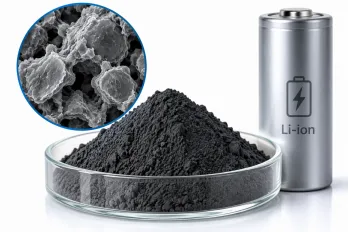
High-Capacity Silicon-Carbon Anode Material is a next-generation anode material designed for high-energy-density lithium-ion batteries. It combines the high theoretical capacity of silicon with the conductivity, structural stability, and volume-expansion buffering capability of carbon materials, thereby improving battery capacity, rate performance, and endurance. Compared with conventional graphite anodes, silicon-carbon anodes offer much higher lithium storage potential and have become an important material pathway for increasing energy density in power batteries and consumer batteries. The core value of this product lies in addressing the battery industry’s trade-offs among endurance, fast charging, lightweight design, and compact size. As electric vehicles move toward longer driving ranges and faster charging platforms, and as smartphones, laptops, drones, wearables, and premium consumer electronics require higher-capacity batteries, High-Capacity Silicon-Carbon Anode Material is accelerating from technical validation and small-batch adoption toward scaled commercialization. It is becoming a key breakthrough area for lithium battery material companies seeking higher product value and stronger customer stickiness.
Global High-Capacity Silicon-Carbon Anode Material Market Size (US$ Million), 2021-2032
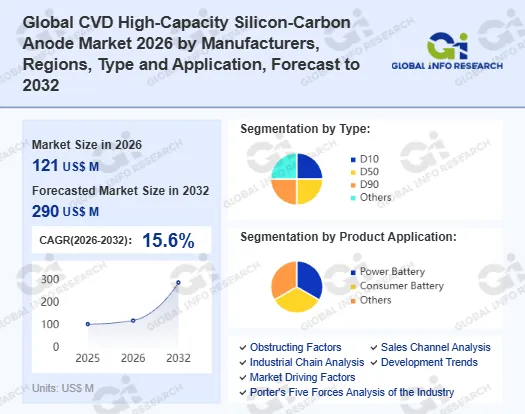
According to the latest research "Global CVD High-Capacity Silicon-Carbon Anode Market 2026 by Manufacturers, Regions, Type and Application, Forecast to 2032" by GIR (Global Info Research), the global CVD High-Capacity Silicon-Carbon Anode market was valued at USD 105 million in 2025 and is expected to reach approximately USD 121 million in 2026. The market is further projected to grow significantly to around USD 290 million by 2032, registering a CAGR of 15.6% during the forecast period. This growth is driven by increasing market demand, technological advancements, and expanding application areas, highlighting strong growth potential and emerging opportunities for industry participants worldwide.
Global High-Capacity Silicon-Carbon Anode Material Top 10 Players Ranking and Market Share (Ranking is based on the revenue of 2025, continually updated)
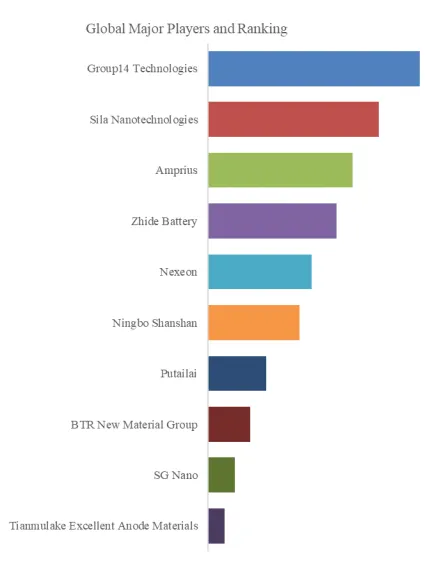
According to Global Info Research Top Players Research Center, the global key manufacturers of High-Capacity Silicon-Carbon Anode Material include Group14 Technologies, Sila Nanotechnologies, Amprius, etc. In 2025, the global top three players had a share approximately 30.3% in terms of revenue.
Industrial Chain
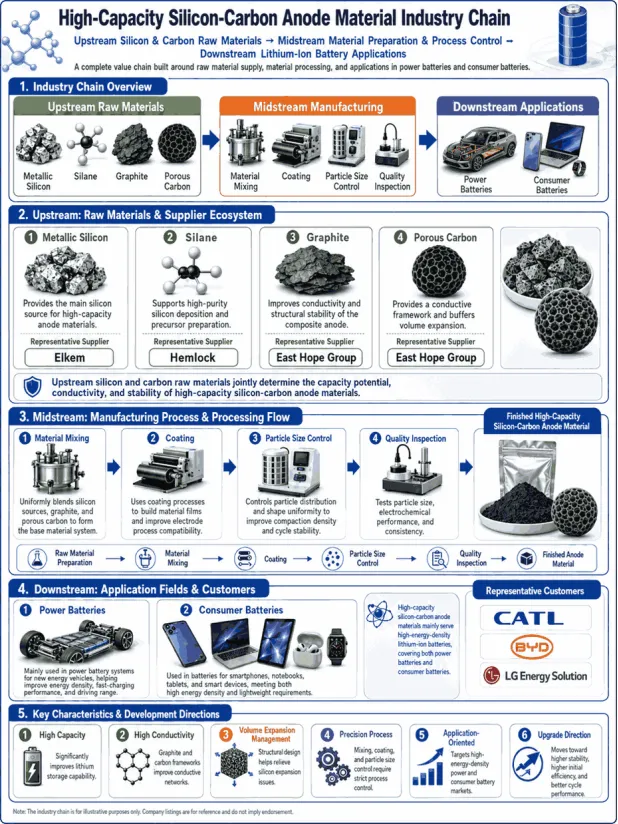
The upstream segment mainly includes metallic silicon, silane, graphite, and porous carbon, with representative suppliers including Elkem, Hemlock, and Eastern Hope Group. Metallic silicon and silane are important sources of silicon-based active materials, and their purity, impurity control, and particle morphology directly affect capacity delivery, initial efficiency, and cycling stability. Graphite provides basic lithium storage, conductivity, and structural support, while porous carbon improves silicon particle dispersion and mitigates volume expansion during lithiation through its pore structure and high specific surface area. As silicon-carbon anodes move toward higher capacity, lower expansion, and stronger stability, upstream competition is shifting from raw material scale supply toward high-purity silicon sources, low impurity control, carbon pore structure design, and batch stability. Upstream suppliers with stable silicon source access, cost control capability, and customized material development capability will be better positioned to enter high-end anode material systems for power batteries and consumer batteries.
The midstream segment focuses on material mixing, coating, and particle size control to ensure material uniformity and electrochemical performance. The key at this stage is not simply blending silicon and carbon materials, but using precise formulation design, nanoscale dispersion control, interfacial coating, particle structure adjustment, and coating consistency management to enable the high-capacity advantage of silicon to be released stably in battery systems. Silicon particles undergo significant volume changes during charge and discharge. If dispersion is uneven, interfacial coating is insufficient, or particle size control is unstable, the electrode may suffer from pulverization, repeated SEI formation, lower initial efficiency, and faster cycle-life degradation. Therefore, midstream manufacturing must systematically optimize mixing uniformity, particle morphology, coating integrity, compacted density, and electrode processing adaptability. Future competitiveness in this segment will depend on low-expansion structural design, stabilization of high-silicon-content materials, continuous production capability, batch consistency control, and customized development for the different performance requirements of power batteries and consumer batteries.
The downstream segment is mainly applied in power batteries and consumer batteries, with representative customers including CATL, BYD, and LG Energy Solution. Power batteries are an important growth market for High-Capacity Silicon-Carbon Anode Material. Long-range vehicles, fast-charging batteries, high-voltage platforms, and premium electric vehicles require higher energy density, better rate performance, and stronger cycling stability. For battery companies such as CATL, BYD, and LG Energy Solution, the adoption of silicon-carbon anodes can improve cell capacity, enhance fast-charging performance, and support differentiated competitiveness in premium power battery products. Consumer batteries focus more on higher capacity per unit volume and thinner product design. Smartphones, tablets, laptops, drones, smart wearables, and premium portable devices all need longer battery life within limited space. Downstream customers evaluate not only capacity indicators, but also cycle life, expansion control, safety margins, batch consistency, cost level, and compatibility with existing battery manufacturing processes.
Industry Chain
Influencing Factors
The industry’s growth is driven by power battery energy density upgrades, fast-charging technology development, thinner and lighter consumer electronics, and localization of high-end battery materials. Conventional graphite anodes are approaching their theoretical capacity ceiling, leaving limited room for further energy density improvement within a pure graphite system. With higher lithium storage capacity, silicon-carbon anodes have become an important upgrade path for the next stage of anode material development. Competition in the electric vehicle market is shifting from pure price competition toward driving range, charging speed, safety, and vehicle energy efficiency. High-Capacity Silicon-Carbon Anode Material can help battery companies build performance advantages in premium models and fast-charging products. Although the overall consumer electronics market is relatively mature, premium devices continue to demand longer battery life, thinner bodies, and improved fast-charging experience, creating a stable high-value application space for silicon-carbon anodes. For material companies, the ability to balance high capacity, low expansion, long cycle life, and low-cost mass production will determine whether they can achieve sustainable profitability across both power battery and consumer battery markets.
The main restraints include silicon volume expansion, relatively low initial coulombic efficiency, high process control difficulty, cost pressure, and long customer qualification cycles. Silicon experiences significant volume change during lithiation, which can cause particle cracking, conductive network failure, and electrode structure damage. This remains the core technical challenge limiting large-scale application of silicon-carbon anodes. To improve cycle life, companies must continue optimizing nanosizing, carbon coating, porous structure design, binder systems, and electrolyte additive coordination, but these measures also increase manufacturing complexity and cost. Power battery customers require high material safety, long-cycle performance, and batch consistency, while consumer battery customers are more sensitive to energy density, volume expansion, and terminal adaptation speed. Both segments require long testing, validation, and supply chain introduction cycles. In addition, High-Capacity Silicon-Carbon Anode Material is not fully plug-and-play with existing battery systems. Electrode formulation, coating process, formation protocol, and battery management strategy may all require adjustment, which can slow commercial adoption.
In the future, High-Capacity Silicon-Carbon Anode Material will develop toward higher silicon content, lower expansion, higher initial efficiency, longer cycle life, and lower-cost mass production. On the product side, nanosilicon design, porous carbon frameworks, composite coating technologies, and interface stability will receive greater attention to reduce structural degradation caused by volume expansion. On the process side, continuous mixing, precision coating, online particle size control, and digital quality inspection will accelerate, improving batch consistency while reducing manufacturing cost. On the application side, adoption will first expand in premium electric vehicles, fast-charging power batteries, high-end smartphones, thin and light laptops, drones, and smart wearable devices. In the long run, High-Capacity Silicon-Carbon Anode Material will become one of the key materials supporting the transition of lithium-ion batteries from cost-driven competition to performance-driven competition. Companies with upstream silicon source control, stable midstream composite processing capability, and downstream customer validation experience will be better positioned to win high-value orders and build sustainable profitability in the next phase of battery material competition.
CVD High-Capacity Silicon-Carbon Anode Report Chapter Summary:
Chapter 1: CVD High-Capacity Silicon-Carbon Anode Industry Definition and Market Overview
This chapter clearly defines the product definition, characteristics, and industry statistical scope of CVD High-Capacity Silicon-Carbon Anode, systematically introduces its mainstream product classifications and key application areas, and presents the overall size and future outlook of the global market.
Chapter 2: In-depth Analysis of Core CVD High-Capacity Silicon-Carbon Anode Companies (2021-2025)
This chapter focuses on the main players in the CVD High-Capacity Silicon-Carbon Anode market. For each representative company, it not only introduces its basic overview, main business, and product portfolio, but also highlights its core operating data in the CVD High-Capacity Silicon-Carbon Anode field, including sales volume, sales revenue, pricing strategies, and the latest development trends of the company from 2021 to 2025.
Chapter 3: Global Competitive Landscape Analysis (2021-2025)
This chapter examines the global CVD High-Capacity Silicon-Carbon Anode competitive landscape from a macro perspective. By comparing the CVD High-Capacity Silicon-Carbon Anode sales volume, pricing, revenue, and market share of major companies from 2021 to 2025, it quantitatively analyzes market concentration and interprets the competitive strategies and market position evolution of core manufacturers.
Chapter 4: CVD High-Capacity Silicon-Carbon Anode Major Regional Market Size and Prospects (2021-2032)
This chapter conducts a regional-level analysis of the global CVD High-Capacity Silicon-Carbon Anode core markets. It will present historical data on the CVD High-Capacity Silicon-Carbon Anode market size (sales volume and revenue from 2021-2025) in major regions such as North America, Europe, and Asia Pacific, and provide market outlook forecasts for 2026-2032.
Chapter 5: CVD High-Capacity Silicon-Carbon Anode Product Type Segmentation Market Forecast (2021-2032)
This chapter delves into the CVD High-Capacity Silicon-Carbon Anode product structure. It will segment the CVD High-Capacity Silicon-Carbon Anode market by different types (such as D10、D50、D90、Others, etc.), and analyze in detail the historical market size of each segmented product category from 2021 to 2025 and the future growth trends from 2026 to 2032.
Chapter 6: CVD High-Capacity Silicon-Carbon Anode Application Field Segmentation Market Forecast (2021-2032)
This chapter delves into the downstream application demand for CVD High-Capacity Silicon-Carbon Anode. The market will be segmented by different application areas (such as Power Battery、Consumer Battery、Others, etc.), presenting the historical market size for each area from 2021-2025 and future demand forecasts from 2026-2032.
Chapters 7-11: In-depth Analysis of Global Regional Markets (2021-2032)
This section is the core module of the CVD High-Capacity Silicon-Carbon Anode report, providing an in-depth country/regional analysis across five major regions: North America, Europe, Asia Pacific, South America, and the Middle East & Africa. The chapter structure for each region is consistent:
Segmentation by Country/Region: Analysis of the market size and forecasts for major countries within the region from 2021-2032.
Segmentation by Product Type: Presentation of the market structure and development forecasts for different product types within the region from 2021-2032.
Segmentation by Application Area: Analysis of market demand and prospects for different application areas within the region from 2021-2032.
Chapter 12: Global CVD High-Capacity Silicon-Carbon Anode Market Dynamics, Challenges, and Trends
This chapter aims to analyze the key internal and external factors affecting the development of the CVD High-Capacity Silicon-Carbon Anode market. It systematically reviews the core drivers of CVD High-Capacity Silicon-Carbon Anode market growth, the main obstacles and challenges faced, and assesses future product, technology, and market development trends.
Chapter 13: CVD High-Capacity Silicon-Carbon Anode Industry Chain Structure Analysis
This chapter analyzes the entire industry chain ecosystem of the CVD High-Capacity Silicon-Carbon Anode industry. From upstream raw material supply to midstream production and manufacturing, and then to downstream end-use applications, it analyzes the current status, cost structure, and collaborative relationships of each link.
Chapter 14: Sales Channel Model Research
This chapter focuses on the distribution channels of CVD High-Capacity Silicon-Carbon Anode products. It analyzes the market share, advantages and disadvantages, and typical cases of mainstream sales channels, and explores the innovation and development trends of channel models.
Chapter 15: Research Conclusions and Strategic Recommendations
As a summary of the report, this chapter will distill the core findings and conclusions of the entire report and, based on a comprehensive understanding of the CVD High-Capacity Silicon-Carbon Anode market, provide actionable strategic development recommendations for industry participants and potential entrants.
For more information, please refer to "Global CVD High-Capacity Silicon-Carbon Anode Market 2026 by Manufacturers, Regions, Type and Application, Forecast to 2032". This report analyzes the supply and demand situation, development status, and changes in the industry, focusing on the development status of the industry, how to face the development challenges of the industry, industry development suggestions, industry competitiveness, and industry investment analysis and trend forecasts. The report also summarizes the overall development dynamics of the industry, including the impact of the latest US tariffs on the global supply chain, the supply relationship analysis of the industrial chain, and provides reference suggestions and specific solutions for the industry in terms of products.
Previous News:
Global TFT Touch Screen Display Market Is Projected to Reach USD 468 Million by 2032, Expanding at a 4.3% CAGR During the 2026–2032 Forecast Period
Next News:
The copyright of this article belongs to Global Info Research. Without the written authorization of our company, no organization or individual may reprint, quote, copy, adapt or use it for commercial purposes in any way. When authorized to use, the original source must be indicated as "Global Info Research" and the complete copyright information must be retained.
- We Provide Professional, Accurate Market Analysis to Help You Stay Ahead of Your Competition.Speak to our analyst >>

Our Clients
What We Can Provide?
With better results and higher quality products,Our professional reports can achieve four things:

Insight into the industry market information

Analyze market development needs

Prospects for future development

Develop industry investment strategy
- Digging deeper into global industry information and providing market strategies.Contact Us >>
- We Provide Professional, Accurate Market Analysis to Help You Stay Ahead of Your Competition.Speak to our analyst >>
Our Clients
What We Can Provide?
With better results and higher quality products,Our professional reports can achieve four things:
Insight into the industry market information
Analyze market development needs
Prospects for future development
Develop industry investment strategy
- Digging deeper into global industry information and providing market strategies.Contact Us >>