
Quick Couplings for Liquid Cooling Market 2026: A 13.5% CAGR Points to a USD 14.41 Million Opportunity by 2032 as AI Data Center Liquid Cooling Scales
Published Date: Tuesday,24 Nov,2026


 EPDM Seals for Liquid Cooling Quick Disconnect Couplings
Quick Couplings for Liquid Cooling Product Definition
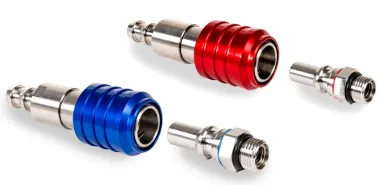
Quick Couplings for Liquid Cooling refer to specialized quick-connect fluid connectors used in liquid cooling systems to enable fast connection and disconnection of cooling fluid lines. They are commonly installed in cold plates, manifolds, cabinets, energy storage battery packs, vehicle thermal management systems, and industrial cooling circuits to support equipment installation, maintenance, and module replacement with minimal or no leakage. These products typically require strong sealing performance, corrosion resistance, pressure resistance, stable flow characteristics, repeated connection reliability, and compatibility with water-based coolants, glycol mixtures, dielectric fluids, or other cooling media.
Global Quick Couplings for Liquid Cooling Market Size (US$ Million), 2021-2032
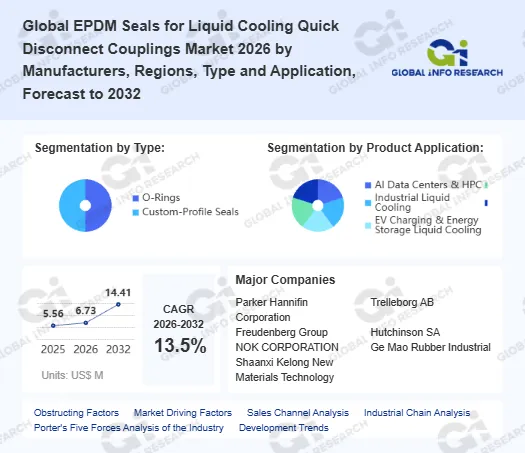
According to the latest report "Global EPDM Seals for Liquid Cooling Quick Disconnect Couplings Market 2026 by Manufacturers, Regions, Type and Application, Forecast to 2032"published by GIR (Global Info Research), the global EPDM Seals for Liquid Cooling Quick Disconnect Couplings market was valued at approximately USD 5.56 million in 2025 and is projected to reach USD 6.73 million in 2026. With a CAGR of 13.5% during the forecast period from 2026 to 2032, the market is expected to further expand to approximately USD 14.41 million by 2032. This growth is driven by increasing market demand, evolving industry trends, and expanding application opportunities worldwide.
Quick Couplings for Liquid Cooling Market Overview
Current Development Status:
Currently, the industry of quick couplings for liquid cooling is evolving from general hydraulic couplings toward liquid-cooling-specific designs, with a focus on low flow resistance and long service life. Some leading players, leveraging long-term technological accumulation, dominate the high-end market, offering products featuring dripless disconnection, high mating cycle life, and excellent temperature and corrosion resistance. Meanwhile, several emerging manufacturers are actively entering the market, with some products already achieving mass application in data centre liquid cooling and energy storage systems. The overall market is characterized by “high growth and high entry barriers,” with particularly strong demand in hyperscale data centres and thermal management systems of new energy vehicles for low-resistance, large-diameter, and intelligent-monitoring quick couplings.
Future Trends:
In the future, quick couplings for liquid cooling will move toward higher integration, intelligent sensing, and standardization. On one hand, as liquid cooling systems evolve toward higher power density and compactness, couplings will integrate sensing functions for flow, temperature, and pressure, enabling self-monitoring and early warning. On the other hand, the industry will promote standardization of interface dimensions and performance testing methods to reduce system integration costs and interoperability risks. Furthermore, lightweight materials and compatibility with eco-friendly coolants will become key R&D focuses. Meanwhile, wear-resistant and self-aligning designs for automated blind-mating and robotic maintenance scenarios will gradually gain adoption.
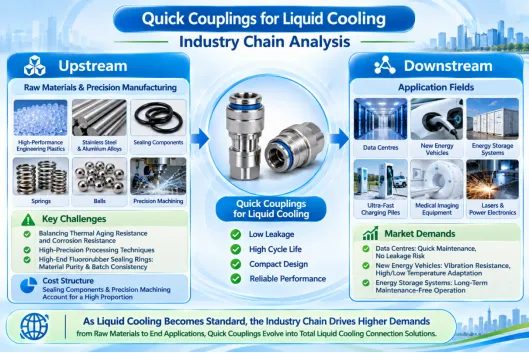
Industry Chain Analysis:
l Upstream
The upstream industry chain of quick couplings for liquid cooling primarily includes raw material suppliers and precision machining sectors, involving high-performance engineering plastics, stainless steel, aluminium alloys, sealing components, springs, and balls. The key challenges upstream lie in balancing long-term thermal aging resistance and corrosion resistance of materials, as well as high-precision processing techniques. In addition, high-end fluor rubber sealing rings still face technical challenges in material purity and batch consistency. In the upstream cost structure, sealing components and precision machining account for a relatively high proportion, directly determining the quality and service life of the couplings.
l Downstream
The downstream application fields include data centres, power battery thermal management, ultra-fast charging piles, energy storage systems, medical imaging equipment, lasers, and power electronics. Currently, the largest incremental market for quick couplings for liquid cooling comes from liquid-cooled servers and liquid-cooled energy storage systems, where end-users impose strict requirements on low leakage rate, high cycle life, and compact size. Downstream demands are diverse: data centres emphasize quick maintenance and no leakage risk; new energy vehicles focus on vibration resistance and resistance to high-low temperature cycles; energy storage systems require long-term maintenance-free operation and corrosion resistance. As liquid cooling transitions from “optional” to “standard,” downstream users raise higher demands on reliability, traceability, and interface compatibility of quick couplings, pushing suppliers to evolve into total liquid cooling connection solution providers.
Industry Leader Introduction

Parker Hannifin is a global leader in motion and control technologies, delivering innovative engineered solutions to diversified industrial and aerospace markets. The company operates under the philosophy of “Engineering Your Success,” adopting a customer-centric approach to product development and offering a broad portfolio including fluid handling, filtration, gas processing, and automation technologies, supported by a strong global distribution network. With over a century of engineering expertise and continuous innovation, Parker is committed to providing highly reliable, energy-efficient, and cost-effective solutions that help customers improve productivity and profitability.
Parker Hannifin Quick Couplings for Liquid Cooling Introduction:

Parker Hannifin’s Quick Couplings for Liquid Cooling are engineered for thermal management in data servers, high-performance computing, and advanced electronics. Featuring flush-face, non-spill valve designs, these couplings virtually eliminate fluid loss during connection and disconnection, protecting sensitive electronic components while ensuring clean and reliable operation. Their low pressure drop and high flow capability enhance energy efficiency and cooling performance, enabling stable operation even under increasing thermal loads.
In terms of design and system integration, Parker’s liquid cooling quick couplings emphasize maximum reliability and ease of use. They offer strong resistance to vibration and mechanical stress, along with a wide range of sealing materials compatible with different temperatures and fluids. With modular designs and standardized interfaces such as UQD specifications, these couplings enable seamless integration into diverse liquid cooling architectures, supporting efficient installation and maintenance while meeting the stringent uptime and reliability requirements of modern data centres.
EPDM Seals for Liquid Cooling Quick Disconnect Couplings Report Chapter Summary:
Chapter 1: EPDM Seals for Liquid Cooling Quick Disconnect Couplings Industry Definition and Market Overview
This chapter clearly defines the product definition, characteristics, and industry statistical scope of EPDM Seals for Liquid Cooling Quick Disconnect Couplings, systematically introduces its mainstream product classifications and key application areas, and presents the overall size and future outlook of the global market.
Chapter 2: In-depth Analysis of Core EPDM Seals for Liquid Cooling Quick Disconnect Couplings Companies (2021-2025)
This chapter focuses on the main players in the EPDM Seals for Liquid Cooling Quick Disconnect Couplings market. For each representative company, it not only introduces its basic overview, main business, and product portfolio, but also highlights its core operating data in the EPDM Seals for Liquid Cooling Quick Disconnect Couplings field, including sales volume, sales revenue, pricing strategies, and the latest development trends of the company from 2021 to 2025.
Chapter 3: Global Competitive Landscape Analysis (2021-2025)
This chapter examines the global EPDM Seals for Liquid Cooling Quick Disconnect Couplings competitive landscape from a macro perspective. By comparing the EPDM Seals for Liquid Cooling Quick Disconnect Couplings sales volume, pricing, revenue, and market share of major companies from 2021 to 2025, it quantitatively analyzes market concentration and interprets the competitive strategies and market position evolution of core manufacturers.
Chapter 4: EPDM Seals for Liquid Cooling Quick Disconnect Couplings Major Regional Market Size and Prospects (2021-2032)
This chapter conducts a regional-level analysis of the global EPDM Seals for Liquid Cooling Quick Disconnect Couplings core markets. It will present historical data on the EPDM Seals for Liquid Cooling Quick Disconnect Couplings market size (sales volume and revenue from 2021-2025) in major regions such as North America, Europe, and Asia Pacific, and provide market outlook forecasts for 2026-2032.
Chapter 5: EPDM Seals for Liquid Cooling Quick Disconnect Couplings Product Type Segmentation Market Forecast (2021-2032)
This chapter delves into the EPDM Seals for Liquid Cooling Quick Disconnect Couplings product structure. It will segment the EPDM Seals for Liquid Cooling Quick Disconnect Couplings market by different types (such as O-Rings、Custom-Profile Seals, etc.), and analyze in detail the historical market size of each segmented product category from 2021 to 2025 and the future growth trends from 2026 to 2032.
Chapter 6: EPDM Seals for Liquid Cooling Quick Disconnect Couplings Application Field Segmentation Market Forecast (2021-2032)
This chapter delves into the downstream application demand for EPDM Seals for Liquid Cooling Quick Disconnect Couplings. The market will be segmented by different application areas (such as AI Data Centers & HPC、Industrial Liquid Cooling、EV Charging & Energy Storage Liquid Cooling、Telecommunications Equipment Cooling、Others, etc.), presenting the historical market size for each area from 2021-2025 and future demand forecasts from 2026-2032.
Chapters 7-11: In-depth Analysis of Global Regional Markets (2021-2032)
This section is the core module of the EPDM Seals for Liquid Cooling Quick Disconnect Couplings report, providing an in-depth country/regional analysis across five major regions: North America, Europe, Asia Pacific, South America, and the Middle East & Africa. The chapter structure for each region is consistent:
Segmentation by Country/Region: Analysis of the market size and forecasts for major countries within the region from 2021-2032.
Segmentation by Product Type: Presentation of the market structure and development forecasts for different product types within the region from 2021-2032.
Segmentation by Application Area: Analysis of market demand and prospects for different application areas within the region from 2021-2032.
Chapter 12: Global EPDM Seals for Liquid Cooling Quick Disconnect Couplings Market Dynamics, Challenges, and Trends
This chapter aims to analyze the key internal and external factors affecting the development of the EPDM Seals for Liquid Cooling Quick Disconnect Couplings market. It systematically reviews the core drivers of EPDM Seals for Liquid Cooling Quick Disconnect Couplings market growth, the main obstacles and challenges faced, and assesses future product, technology, and market development trends.
Chapter 13: EPDM Seals for Liquid Cooling Quick Disconnect Couplings Industry Chain Structure Analysis
This chapter analyzes the entire industry chain ecosystem of the EPDM Seals for Liquid Cooling Quick Disconnect Couplings industry. From upstream raw material supply to midstream production and manufacturing, and then to downstream end-use applications, it analyzes the current status, cost structure, and collaborative relationships of each link.
Chapter 14: Sales Channel Model Research
This chapter focuses on the distribution channels of EPDM Seals for Liquid Cooling Quick Disconnect Couplings products. It analyzes the market share, advantages and disadvantages, and typical cases of mainstream sales channels, and explores the innovation and development trends of channel models.
Chapter 15: Research Conclusions and Strategic Recommendations
As a summary of the report, this chapter will distill the core findings and conclusions of the entire report and, based on a comprehensive understanding of the EPDM Seals for Liquid Cooling Quick Disconnect Couplings market, provide actionable strategic development recommendations for industry participants and potential entrants.
For more information, please refer to "Global EPDM Seals for Liquid Cooling Quick Disconnect Couplings Market 2026 by Manufacturers, Regions, Type and Application, Forecast to 2032". This report analyzes the supply and demand situation, development status, and changes in the industry, focusing on the development status of the industry, how to face the development challenges of the industry, industry development suggestions, industry competitiveness, and industry investment analysis and trend forecasts. The report also summarizes the overall development dynamics of the industry, including the impact of the latest US tariffs on the global supply chain, the supply relationship analysis of the industrial chain, and provides reference suggestions and specific solutions for the industry in terms of products.
Previous News:
Disposable Stone Extraction Basket Market 2026: A 3.4% CAGR Points to a USD 407 Million Opportunity by 2032 as Ureteroscopy and Laser Lithotripsy Volumes Rise
Next News:
The copyright of this article belongs to Global Info Research. Without the written authorization of our company, no organization or individual may reprint, quote, copy, adapt or use it for commercial purposes in any way. When authorized to use, the original source must be indicated as "Global Info Research" and the complete copyright information must be retained.
- We Provide Professional, Accurate Market Analysis to Help You Stay Ahead of Your Competition.Speak to our analyst >>

Our Clients
What We Can Provide?
With better results and higher quality products,Our professional reports can achieve four things:

Insight into the industry market information

Analyze market development needs

Prospects for future development

Develop industry investment strategy
- Digging deeper into global industry information and providing market strategies.Contact Us >>
- We Provide Professional, Accurate Market Analysis to Help You Stay Ahead of Your Competition.Speak to our analyst >>
Our Clients
What We Can Provide?
With better results and higher quality products,Our professional reports can achieve four things:
Insight into the industry market information
Analyze market development needs
Prospects for future development
Develop industry investment strategy
- Digging deeper into global industry information and providing market strategies.Contact Us >>