
Industrial Access Control System Market 2026: A 6.4% CAGR Points to a USD 3,949 Million Opportunity by 2032 as Smart Factory and Critical Infrastructure Upgrades Accelerate
Published Date: Thursday,26 Nov,2026


 Industrial Access Control System
 Market Summary
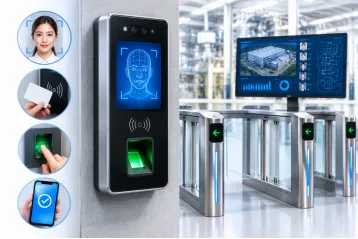
Industrial Access Control System refers to an identity verification and access management system deployed in factories, industrial parks, warehouses, energy facilities, data centers, and other industrial environments. It is designed to authenticate, record, interlink, and audit access privileges for personnel, vehicles, and specific zones, thereby ensuring that only authorized entities can enter designated areas or utilize specific facilities. Its core components typically include card readers, biometric terminals, controllers, electronic locks, visitor management systems, and access management software platforms, as well as integration capabilities with video surveillance, alarm systems, building management systems, or broader industrial security platforms.
Global Industrial Access Control System Market Size (US$ Million), 2025 VS 2032
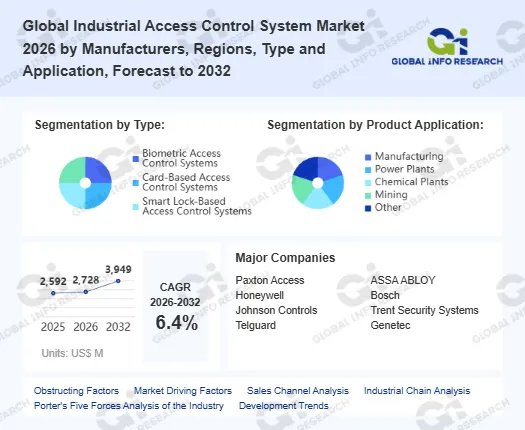
According to the latest report "Global Industrial Access Control System Market 2026 by Manufacturers, Regions, Type and Application, Forecast to 2032"published by GIR (Global Info Research), the global Industrial Access Control System market was valued at approximately USD 2592 million in 2025 and is projected to reach USD 2728 million in 2026. With a CAGR of 6.4% during the forecast period from 2026 to 2032, the market is expected to further expand to approximately USD 3949 million by 2032. This growth is driven by increasing market demand, evolving industry trends, and expanding application opportunities worldwide.
Global Industrial Access Control System Top 10 Players Ranking and Market Share (Ranking is based on the revenue of 2025, continually updated)
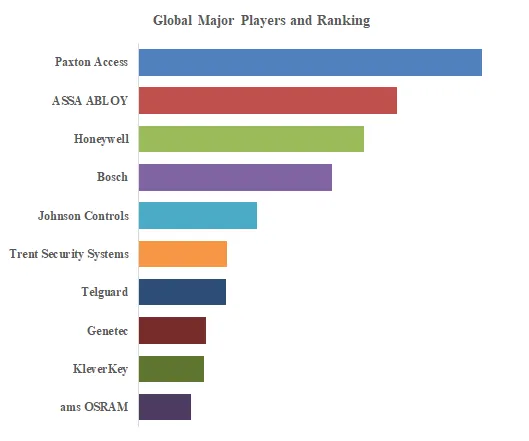
According to Global Info Research Top Players Research Center, the global key manufacturers of Industrial Access Control System include Paxton Access, ASSA ABLOY, Honeywell, Bosch, Johnson Controls, etc. In 2025, the global top four players had a share approximately 26% in terms of revenue.
Table 1. Industrial Access Control System Industry Chain Analysis
|
|
Item |
Description |
|
Upstream |
Hardware and Technology |
The upstream segment primarily encompasses access controllers, card readers, biometric modules, door locks/electromagnetic locks, turnstiles, sensors, industrial cameras, communication modules, embedded chips, recognition algorithms, databases, and encryption security technologies. Among these components, chips, sensors, identity recognition algorithms, and cybersecurity technologies constitute the core foundation that determines a system's stability and security level. As industrial environments increasingly demand explosion-proofing, dust-proofing, waterproofing, resistance to extreme temperatures, electromagnetic interference immunity, and high reliability, upstream components are progressively upgrading toward industrial-grade, modular, and intelligent solutions. |
|
Midstream |
Equipment Manufacturers |
The core competitiveness within this segment is manifested in system stability, compatibility, scalability, data security capabilities, and the ability to seamlessly integrate with MES, ERP, EHS, smart campus management, building automation, and video surveillance platforms. International enterprises typically hold distinct advantages in terms of brand reputation and industry certifications within high-end industrial parks, as well as in the energy, chemical, transportation, and large-scale manufacturing sectors. Conversely, Chinese enterprises demonstrate strong competitiveness in cost control, localized services, project delivery speed, and smart campus integration. |
|
Downstream |
Application Scenarios and Demands |
Compared to standard commercial access control systems, industrial access control systems place a greater emphasis on security zone management, granular control over personnel access privileges, access management for hazardous areas, production zone protection, personnel movement tracking, integrated emergency evacuation protocols, and compliance auditing. Looking ahead—driven by the continuous advancement of industrial digitalization, smart factories, the Industrial Internet, and increasingly stringent safety production regulations—industrial access control systems are poised to evolve from mere standalone entry/exit control devices into comprehensive industrial security management platforms encompassing "identity authentication + video integration + personnel positioning + safety compliance + data analytics." Consequently, the value within the industry chain is expected to increasingly converge toward software platforms, system integration, data security, and long-term operation and maintenance services. |
Figure00001. Industrial Access Control System Industry Chain

Table 2. Industrial Access Control System Industry Policy Analysis
|
|
Policy |
Description |
|
1 |
U.S. policy |
In the realm of building and fire safety, U.S. policy places particular emphasis on balancing "security control" with "unimpeded egress." UL Solutions notes that a balance must be struck between building safety and access control security; most national codes mandate that occupants be able to evacuate freely and without obstruction, and that doors on the egress side must open without reliance on tools, keys, or specialized knowledge. Consequently, when industrial access control systems are deployed in factories, warehouses, data centers, chemical facilities, and public buildings across the U.S., they must be integrated in a compliant manner with fire alarm systems, emergency exit mechanisms, power-loss release devices, "Request-to-Exit" buttons, and delayed egress devices. Within the critical infrastructure sector, the U.S. places even greater emphasis on the convergence of cybersecurity and physical security. Taking the electric power industry as an example, the CIP standards established by FERC and NERC continuously reinforce the protection of cyber assets within power systems. A 2025 FERC filing regarding NERC CIP-003-11 stipulates that this standard requires entities associated with "low-impact" Bulk Electric System (BES) cyber systems to establish security management controls. The objective is to mitigate the risk of operational errors or grid instability resulting from coordinated cyberattacks targeting the system. The filing further notes that these controls include authenticating remote users, protecting authentication information during transmission, and detecting malicious communications. The implication for industrial access control systems is this: in high-security environments—such as power plants, energy facilities, transportation hubs, and data centers—access control systems must do more than simply regulate "who can enter." They must also demonstrate that their remote access capabilities, audit logging, account privilege management, communication encryption, and vendor maintenance channels are secure and subject to effective control. |
|
2 |
EU policies |
Europe imposes extremely stringent regulations on the handling of personal and biometric data within access control systems. If an industrial access control system incorporates features involving employee identity information, access logs, facial recognition, fingerprint scanning, or iris recognition, it must comply with the requirements of the GDPR. The GDPR explicitly designates "biometric data for the purpose of uniquely identifying a natural person" as a special category of personal data; in principle, the processing of such data is prohibited unless specific lawful conditions are met. Consequently, when deploying biometric access control systems in European industrial parks, factories, energy facilities, or data centers, enterprises are typically required to conduct legitimacy assessments, practice data minimization, implement access privilege controls, utilize encrypted storage, manage data retention periods, and conduct Data Protection Impact Assessments (DPIAs). Furthermore, the European Union's Cyber Resilience Act (CRA) imposes even higher requirements on connected hardware and software products. The European Commission notes that the CRA mandates that hardware and software products incorporating digital elements must meet mandatory cybersecurity requirements during their planning, design, development, and maintenance phases, and requires manufacturers to address vulnerabilities throughout the product lifecycle. The Act entered into force on December 10, 2024; while the primary obligations will apply starting December 11, 2027, the obligations regarding vulnerability reporting will take effect on September 11, 2026. For companies in the industrial access control sector, future products entering the European market—including controllers, card readers, access control platforms, cloud-based management software, and networked biometric terminals—will need to place greater emphasis on secure design, vulnerability response, firmware updates, default password management, and supply chain security. |
Table 3. Industrial Access Control System Industry Development Trends
|
|
Development Trends |
Description |
|
1 |
Upgrading from traditional, standalone "card-swipe" security devices to integrated platforms. |
As digitalization advances across manufacturing, smart factories, energy and chemical complexes, warehousing and logistics, data centers, and critical infrastructure, the value of access control systems is no longer confined to mere personnel entry and exit control. Instead, it is gradually expanding to encompass scenarios such as access privilege management, visitor management, attendance system integration, video surveillance linkage, zone-based security segmentation, emergency evacuation, and compliance auditing. |
|
2 |
Evolving toward biometric authentication, mobile credentials, cloud platforms, AI analytics, and multi-system integration. |
While traditional IC cards, PIN codes, and access controllers remain foundational components, newer methods—such as facial recognition, fingerprint scanning, palm vein recognition, and mobile credentials utilizing QR codes, NFC, or Bluetooth—are gaining increasing traction. These advanced methods are particularly well-suited for high-security zones, contactless access scenarios, and the authorization of temporary visitors. Cloud-based and hybrid cloud deployment models are also becoming rapidly widespread, enabling enterprises to achieve unified management across multiple facilities, remote access privilege provisioning, real-time alerting, and centralized auditing. Concurrently, AI technologies are being deployed to facilitate the detection of unauthorized access, tailgating prevention, blacklist alerts, behavioral analytics, and the coordinated response to security incidents. |
|
3 |
The industry is poised to exhibit a trend characterized by "intelligent hardware, platform-based software, and long-term service." |
On the hardware front—including access readers, controllers, electronic locks, turnstiles, industrial doors, and sensors—there is a distinct trend toward upgrading to industrial-grade specifications. This entails achieving higher protection ratings, explosion-proofing, dust and water resistance, resilience to extreme temperatures, and immunity to electromagnetic interference. On the software side, development is gravitating toward SaaS models, on-premise platforms, mobile-centric management interfaces, and unified identity authentication platforms. Furthermore, the service delivery model is shifting away from one-off equipment sales toward a comprehensive, full-lifecycle service approach—encompassing installation and commissioning, system integration, managed operations and maintenance, access policy design, data security management, and periodic system upgrades. |
Table 4. Industrial Access Control System Industry Development Opportunities
|
|
Development Opportunities |
Description |
|
1 |
The transformation of smart factories and industrial parks presents opportunities for system upgrades. |
Settings such as manufacturing facilities, chemical industrial parks, energy hubs, semiconductor plants, data centers, and warehousing and logistics parks are facing increasingly stringent requirements for the management of personnel, vehicles, visitors, contractors, and external personnel. Traditional card-based access control systems struggle to meet the complex management demands associated with multiple zones, tiered access privileges, shift-based operations, and diverse identity types. Consequently, this trend is driving enterprises to procure higher-grade access control systems, visitor management systems, turnstile and access lane systems, vehicle access control systems, and unified security management platforms. For vendors, opportunities are concentrated in areas such as the replacement of legacy access control systems, centralized management across multiple plant sites, and the construction of integrated security platforms for industrial parks. |
|
2 |
High-security sectors offer opportunities for high-value-added projects. |
Industries such as electric power, petrochemicals, rail transit, defense, aviation, maritime ports, pharmaceuticals, semiconductors, and data centers impose particularly high standards regarding the stability, security, and regulatory compliance of access control systems. These sectors typically require advanced features such as explosion-proofing, dust and water resistance, extreme temperature tolerance, electromagnetic interference immunity, dual-person authorization, multi-factor authentication, access log traceability, and emergency response linkages. Such clients prioritize reliability and project delivery capabilities over price sensitivity, thereby creating substantial profit margins for providers of high-end industrial access control hardware, customized system integration solutions, and long-term operation and maintenance services. |
|
3 |
Biometrics and contactless access solutions create opportunities for product upgrades. |
Technologies such as facial recognition, fingerprint scanning, palm vein recognition, iris scanning, QR codes, NFC, and Bluetooth-based mobile credentials are transforming traditional access control methods. In industrial environments—where employees may be wearing gloves, hard hats, face masks, or protective gear—reliance on a single mode of identification is often impractical; consequently, the demand for multi-modal recognition and combined authentication methods is expected to rise in the future. For instance, high-risk zones could implement authentication protocols such as "employee ID card + facial recognition," "mobile credential + dynamic QR code," or "facial recognition + safety training qualification verification." This trend will generate significant growth opportunities for vendors specializing in smart card readers, biometric terminals, mobile access credentials, and identity authentication software. |
Industrial Access Control System Report Chapter Summary:
Chapter 1: Industrial Access Control System Industry Definition and Market Overview
This chapter clearly defines the product definition, characteristics, and industry statistical scope of Industrial Access Control System, systematically introduces its mainstream product classifications and key application areas, and presents the overall size and future outlook of the global market.
Chapter 2: In-depth Analysis of Core Industrial Access Control System Companies (2021-2025)
This chapter focuses on the main players in the Industrial Access Control System market. For each representative company, it not only introduces its basic overview, main business, and product portfolio, but also highlights its core operating data in the Industrial Access Control System field, including sales volume, sales revenue, pricing strategies, and the latest development trends of the company from 2021 to 2025.
Chapter 3: Global Competitive Landscape Analysis (2021-2025)
This chapter examines the global Industrial Access Control System competitive landscape from a macro perspective. By comparing the Industrial Access Control System sales volume, pricing, revenue, and market share of major companies from 2021 to 2025, it quantitatively analyzes market concentration and interprets the competitive strategies and market position evolution of core manufacturers.
Chapter 4: Industrial Access Control System Major Regional Market Size and Prospects (2021-2032)
This chapter conducts a regional-level analysis of the global Industrial Access Control System core markets. It will present historical data on the Industrial Access Control System market size (sales volume and revenue from 2021-2025) in major regions such as North America, Europe, and Asia Pacific, and provide market outlook forecasts for 2026-2032.
Chapter 5: Industrial Access Control System Product Type Segmentation Market Forecast (2021-2032)
This chapter delves into the Industrial Access Control System product structure. It will segment the Industrial Access Control System market by different types (such as Biometric Access Control Systems、Card-Based Access Control Systems、Smart Lock-Based Access Control Systems、Other, etc.), and analyze in detail the historical market size of each segmented product category from 2021 to 2025 and the future growth trends from 2026 to 2032.
Chapter 6: Industrial Access Control System Application Field Segmentation Market Forecast (2021-2032)
This chapter delves into the downstream application demand for Industrial Access Control System. The market will be segmented by different application areas (such as Manufacturing、Power Plants、Chemical Plants、Mining、Other, etc.), presenting the historical market size for each area from 2021-2025 and future demand forecasts from 2026-2032.
Chapters 7-11: In-depth Analysis of Global Regional Markets (2021-2032)
This section is the core module of the Industrial Access Control System report, providing an in-depth country/regional analysis across five major regions: North America, Europe, Asia Pacific, South America, and the Middle East & Africa. The chapter structure for each region is consistent:
Segmentation by Country/Region: Analysis of the market size and forecasts for major countries within the region from 2021-2032.
Segmentation by Product Type: Presentation of the market structure and development forecasts for different product types within the region from 2021-2032.
Segmentation by Application Area: Analysis of market demand and prospects for different application areas within the region from 2021-2032.
Chapter 12: Global Industrial Access Control System Market Dynamics, Challenges, and Trends
This chapter aims to analyze the key internal and external factors affecting the development of the Industrial Access Control System market. It systematically reviews the core drivers of Industrial Access Control System market growth, the main obstacles and challenges faced, and assesses future product, technology, and market development trends.
Chapter 13: Industrial Access Control System Industry Chain Structure Analysis
This chapter analyzes the entire industry chain ecosystem of the Industrial Access Control System industry. From upstream raw material supply to midstream production and manufacturing, and then to downstream end-use applications, it analyzes the current status, cost structure, and collaborative relationships of each link.
Chapter 14: Sales Channel Model Research
This chapter focuses on the distribution channels of Industrial Access Control System products. It analyzes the market share, advantages and disadvantages, and typical cases of mainstream sales channels, and explores the innovation and development trends of channel models.
Chapter 15: Research Conclusions and Strategic Recommendations
As a summary of the report, this chapter will distill the core findings and conclusions of the entire report and, based on a comprehensive understanding of the Industrial Access Control System market, provide actionable strategic development recommendations for industry participants and potential entrants.
For more information, please refer to "Global Industrial Access Control System Market 2026 by Manufacturers, Regions, Type and Application, Forecast to 2032". This report analyzes the supply and demand situation, development status, and changes in the industry, focusing on the development status of the industry, how to face the development challenges of the industry, industry development suggestions, industry competitiveness, and industry investment analysis and trend forecasts. The report also summarizes the overall development dynamics of the industry, including the impact of the latest US tariffs on the global supply chain, the supply relationship analysis of the industrial chain, and provides reference suggestions and specific solutions for the industry in terms of products.
Previous News:
Global Uncoated Rice Cooker Market Is Set for 8.4% CAGR Growth, Reaching an Estimated USD 1,361 Million by 2032, According to the Latest 2026 Industry Report
Next News:
4D Imaging Radar Module Market 2026: An 18.7% CAGR Points to a USD 9,836 Million Opportunity by 2032 as L2+ to L4 Autonomy Demand Accelerates
The copyright of this article belongs to Global Info Research. Without the written authorization of our company, no organization or individual may reprint, quote, copy, adapt or use it for commercial purposes in any way. When authorized to use, the original source must be indicated as "Global Info Research" and the complete copyright information must be retained.
- We Provide Professional, Accurate Market Analysis to Help You Stay Ahead of Your Competition.Speak to our analyst >>

Our Clients
What We Can Provide?
With better results and higher quality products,Our professional reports can achieve four things:

Insight into the industry market information

Analyze market development needs

Prospects for future development

Develop industry investment strategy
- Digging deeper into global industry information and providing market strategies.Contact Us >>
- We Provide Professional, Accurate Market Analysis to Help You Stay Ahead of Your Competition.Speak to our analyst >>
Our Clients
What We Can Provide?
With better results and higher quality products,Our professional reports can achieve four things:
Insight into the industry market information
Analyze market development needs
Prospects for future development
Develop industry investment strategy
- Digging deeper into global industry information and providing market strategies.Contact Us >>