
Global Flue Gas Desulfurization Service Market Valued at US$7.15 Billion in 2026, Projected to Reach US$11.66 Billion by 2032 at 8.0% CAGR
Published Date: Thursday,20 Aug,2026


 Flue Gas Desulfurization Service
 Market Summary
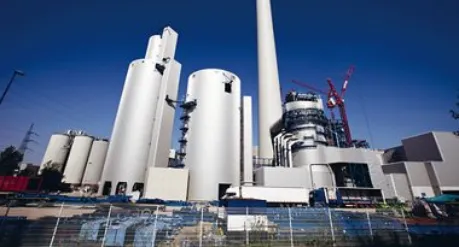
Flue Gas Desulfurization Service refers to specialized environmental engineering services that remove sulfur dioxide (SO₂) from industrial flue gas generated during combustion processes. It includes system design, EPC engineering, equipment integration, installation, and operation & maintenance services. This service is widely applied in coal-fired power plants, steel, cement, and chemical industries to meet strict emission regulations and support industrial decarbonization and cleaner production.
Figure1. Global Flue Gas Desulfurization Service Market Size (US$ Million)
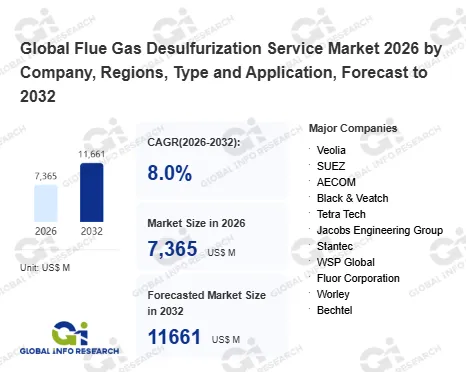
According to the latest report published "Global Flue Gas Desulfurization Service Market 2026 by Manufacturers, Regions, Type and Application, Forecast to 2032"by GIR (Global Info Research), the global Flue Gas Desulfurization Service market was valued at approximately USD 7146 million and is projected to reach USD 11661 million in the coming years, expanding at a CAGR of 8.0%. This growth reflects sustained market momentum and increasing opportunities driven by evolving industry demand and emerging application scenarios.
This growth is primarily driven by increasingly stringent environmental regulations on sulfur dioxide (SO₂) emissions, accelerated retrofitting of coal-fired power plants, and continuous upgrades in industrial emission control systems. In addition, growing investments in industrial decarbonization and cleaner energy transitions across major economies are further supporting market expansion.
From a structural perspective, the market is characterized by relatively high concentration, with leading EPC and environmental engineering companies dominating large-scale projects and long-term service contracts. Overall, the market is transitioning from traditional installation-based demand toward integrated service-oriented and lifecycle O&M-driven models.
Figure 2. Global Flue Gas Desulfurization Service Top 5 Players Ranking and Market Share (Ranking is based on the revenue of 2026, continually updated)
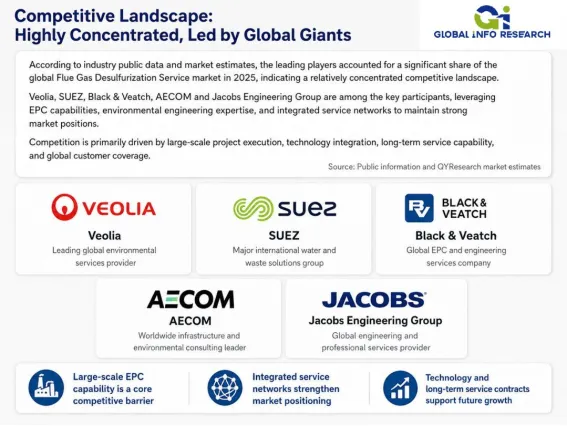
Leading players such as Veolia, SUEZ, Black & Veatch, AECOM, and Jacobs Engineering Group dominate the market due to their strong EPC execution capabilities, advanced environmental engineering expertise, and extensive integrated service networks. These companies are able to provide full-cycle solutions, including design, construction, operation, and long-term maintenance services, which strengthens their competitive positioning in large-scale industrial projects.
Competition in the market is primarily driven by project execution capability, technology integration level, global delivery capacity, and long-term service contract stability. In addition, strong client relationships in the power generation and heavy industrial sectors further reinforce the leadership positions of top-tier players.
Overall, the market remains structurally consolidated, with global EPC giants maintaining dominance, while regional players mainly compete in localized and mid-scale environmental engineering projects.
Figure3. Flue Gas Desulfurization Service, Global Market Size, Split by Product Segment
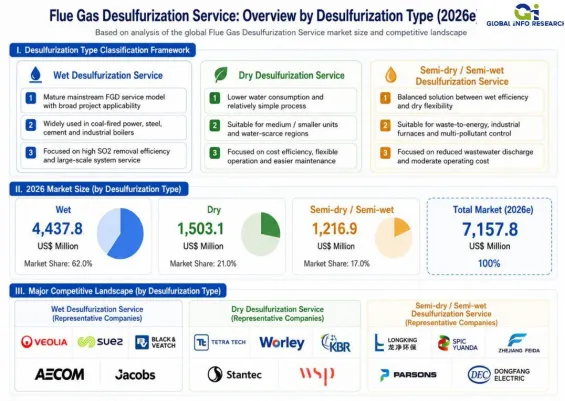
Wet Desulfurization Service remains the dominant segment, accounting for approximately USD 4,437.8 million in 2026, or 62.0% of the total market. This technology is widely adopted in coal-fired power plants and large-scale industrial facilities due to its high SO₂ removal efficiency, mature technology base, and strong suitability for continuous, large-capacity operations.
Dry Desulfurization Service represents a smaller but stable segment, with a market size of about USD 1,503.1 million (21.0%) in 2026. It is primarily used in medium and small industrial units and in regions with water scarcity, as it offers lower water consumption, simpler system design, and relatively lower operating complexity.
Semi-dry / Semi-wet Desulfurization Service accounts for around USD 1,216.9 million (17.0%), serving as a balanced solution between wet and dry technologies. It is increasingly adopted in waste-to-energy plants and industrial furnaces where moderate efficiency and flexible operational requirements are needed.
Figure4. Flue Gas Desulfurization Service, Global Market Size, Split by Application Segment
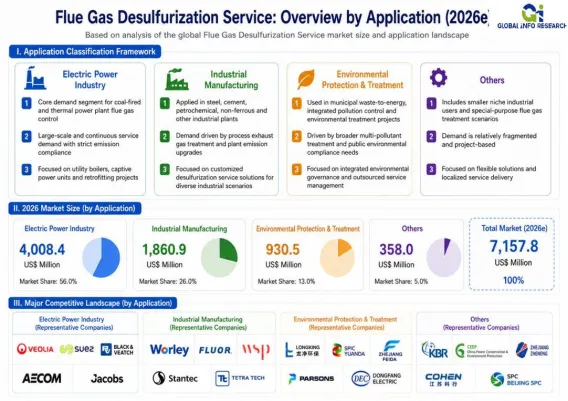
The FGD service market is segmented into Electric Power Industry, Industrial Manufacturing, Environmental Protection & Treatment, and Others.
The Electric Power Industry remains the largest application segment, driven by coal-fired power generation and strict emission control requirements.
Industrial Manufacturing follows, supported by emission upgrades in steel, cement, and chemical industries.
Environmental Protection & Treatment continues to grow steadily due to increasing municipal pollution control and integrated environmental projects, while Other applications represent smaller, project-based demand.
Figure 5. Flue Gas Desulfurization Service, Global Market Size, Split by Region
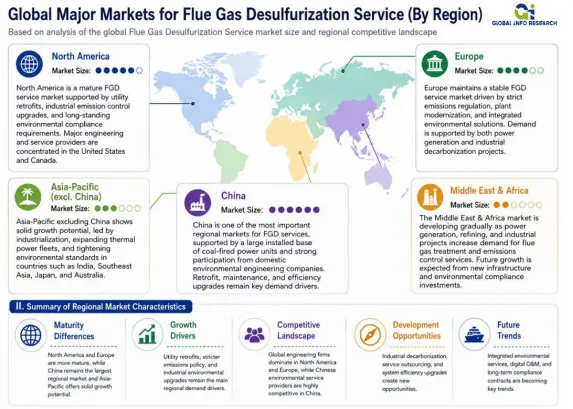
The global Flue Gas Desulfurization Service market is distributed across five major regions: North America, Europe, Asia-Pacific (excl. China), China, and Middle East & Africa.
North America and Europe represent mature markets with strong environmental regulations and a high concentration of established EPC and environmental service providers.
China is a key regional market, driven by a large installed base of coal-fired power plants and continuous demand for retrofit and efficiency upgrades.
Asia-Pacific (excluding China) shows strong growth potential, supported by industrialization and expanding power generation capacity, while Middle East & Africa is still in a developing stage with increasing investment in industrial infrastructure and emissions control projects.
Overall, the market growth is increasingly driven by Asia-Pacific regions, while North America and Europe remain technology and service hubs.
Flue Gas Desulfurization Service, Industry Trends
The global Flue Gas Desulfurization Service market is a highly structured and moderately consolidated industry, driven by increasing environmental compliance requirements and the continuous need for industrial emission control. The market is primarily supported by large-scale applications in power generation and heavy industrial sectors, where long-term service contracts and EPC-based delivery models dominate. Leading global engineering and environmental service providers hold significant market share due to their strong technical capabilities, integrated service networks, and project execution experience across multiple regions.
The FGD service market is expected to maintain steady growth, supported by tightening global emissions regulations, ongoing coal-fired power plant retrofits, and accelerating industrial decarbonization initiatives. Future demand will increasingly shift toward integrated service models combining engineering, digital monitoring, and long-term operation & maintenance (O&M) services. In addition, growth opportunities will be concentrated in emerging economies, particularly in Asia-Pacific and Middle East regions, where industrial expansion and environmental infrastructure investments are accelerating. Meanwhile, technological upgrades focusing on higher efficiency, lower water consumption, and cost optimization will further reshape competitive dynamics in the industry.
Flue Gas Desulfurization Service Report Chapter Summary:
Chapter 1: Flue Gas Desulfurization Service Industry Definition and Market Overview
This chapter clearly defines the product definition, characteristics, and industry statistical scope of Flue Gas Desulfurization Service, systematically introduces its mainstream product classifications and key application areas, and presents the overall size and future outlook of the global market.
Chapter 2: In-depth Analysis of Core Flue Gas Desulfurization Service Companies (2021-2025)
This chapter focuses on the main players in the Flue Gas Desulfurization Service market. For each representative company, it not only introduces its basic overview, main business, and product portfolio, but also highlights its core operating data in the Flue Gas Desulfurization Service field, including sales volume, sales revenue, pricing strategies, and the latest development trends of the company from 2021 to 2025.
Chapter 3: Global Competitive Landscape Analysis (2021-2025)
This chapter examines the global Flue Gas Desulfurization Service competitive landscape from a macro perspective. By comparing the Flue Gas Desulfurization Service sales volume, pricing, revenue, and market share of major companies from 2021 to 2025, it quantitatively analyzes market concentration and interprets the competitive strategies and market position evolution of core manufacturers.
Chapter 4: Flue Gas Desulfurization Service Major Regional Market Size and Prospects (2021-2032)
This chapter conducts a regional-level analysis of the global Flue Gas Desulfurization Service core markets. It will present historical data on the Flue Gas Desulfurization Service market size (sales volume and revenue from 2021-2025) in major regions such as North America, Europe, and Asia Pacific, and provide market outlook forecasts for 2026-2032.
Chapter 5: Flue Gas Desulfurization Service Product Type Segmentation Market Forecast (2021-2032)
This chapter delves into the Flue Gas Desulfurization Service product structure. It will segment the Flue Gas Desulfurization Service market by different types (such as Wet Desulfurization、Dry Desulfurization、Semi-dry/semi-wet, etc.), and analyze in detail the historical market size of each segmented product category from 2021 to 2025 and the future growth trends from 2026 to 2032.
Chapter 6: Flue Gas Desulfurization Service Application Field Segmentation Market Forecast (2021-2032)
This chapter delves into the downstream application demand for Flue Gas Desulfurization Service. The market will be segmented by different application areas (such as Electric Power Industry、Industrial Manufacturing、Environmental Treatment、Other, etc.), presenting the historical market size for each area from 2021-2025 and future demand forecasts from 2026-2032.
Chapters 7-11: In-depth Analysis of Global Regional Markets (2021-2032)
This section is the core module of the Flue Gas Desulfurization Service report, providing an in-depth country/regional analysis across five major regions: North America, Europe, Asia Pacific, South America, and the Middle East & Africa. The chapter structure for each region is consistent:
Segmentation by Country/Region: Analysis of the market size and forecasts for major countries within the region from 2021-2032.
Segmentation by Product Type: Presentation of the market structure and development forecasts for different product types within the region from 2021-2032.
Segmentation by Application Area: Analysis of market demand and prospects for different application areas within the region from 2021-2032.
Chapter 12: Global Flue Gas Desulfurization Service Market Dynamics, Challenges, and Trends
This chapter aims to analyze the key internal and external factors affecting the development of the Flue Gas Desulfurization Service market. It systematically reviews the core drivers of Flue Gas Desulfurization Service market growth, the main obstacles and challenges faced, and assesses future product, technology, and market development trends.
Chapter 13: Flue Gas Desulfurization Service Industry Chain Structure Analysis
This chapter analyzes the entire industry chain ecosystem of the Flue Gas Desulfurization Service industry. From upstream raw material supply to midstream production and manufacturing, and then to downstream end-use applications, it analyzes the current status, cost structure, and collaborative relationships of each link.
Chapter 14: Sales Channel Model Research
This chapter focuses on the distribution channels of Flue Gas Desulfurization Service products. It analyzes the market share, advantages and disadvantages, and typical cases of mainstream sales channels, and explores the innovation and development trends of channel models.
Chapter 15: Research Conclusions and Strategic Recommendations
As a summary of the report, this chapter will distill the core findings and conclusions of the entire report and, based on a comprehensive understanding of the Flue Gas Desulfurization Service market, provide actionable strategic development recommendations for industry participants and potential entrants.
For more information, please refer to "Global Flue Gas Desulfurization Service Market 2026 by Manufacturers, Regions, Type and Application, Forecast to 2032". This report analyzes the supply and demand situation, development status, and changes in the industry, focusing on the development status of the industry, how to face the development challenges of the industry, industry development suggestions, industry competitiveness, and industry investment analysis and trend forecasts. The report also summarizes the overall development dynamics of the industry, including the impact of the latest US tariffs on the global supply chain, the supply relationship analysis of the industrial chain, and provides reference suggestions and specific solutions for the industry in terms of products.
Previous News:
Global Micronized Polyamide Wax Market Valued at US$101 Million in 2026, Projected to Reach US$137 Million by 2032 at 4.6% CAGR
Next News:
Global Binder for Lithium-ion Battery Anode Materials Market Valued at US$893 Million in 2026, Projected to Reach US$1.43 Billion by 2032 at 8.1% CAGR
The copyright of this article belongs to Global Info Research. Without the written authorization of our company, no organization or individual may reprint, quote, copy, adapt or use it for commercial purposes in any way. When authorized to use, the original source must be indicated as "Global Info Research" and the complete copyright information must be retained.
- We Provide Professional, Accurate Market Analysis to Help You Stay Ahead of Your Competition.Speak to our analyst >>

Our Clients
What We Can Provide?
With better results and higher quality products,Our professional reports can achieve four things:

Insight into the industry market information

Analyze market development needs

Prospects for future development

Develop industry investment strategy
- Digging deeper into global industry information and providing market strategies.Contact Us >>
- We Provide Professional, Accurate Market Analysis to Help You Stay Ahead of Your Competition.Speak to our analyst >>
Our Clients
What We Can Provide?
With better results and higher quality products,Our professional reports can achieve four things:
Insight into the industry market information
Analyze market development needs
Prospects for future development
Develop industry investment strategy
- Digging deeper into global industry information and providing market strategies.Contact Us >>