
Global Binder for Lithium-ion Battery Anode Materials Market Valued at US$893 Million in 2026, Projected to Reach US$1.43 Billion by 2032 at 8.1% CAGR
Published Date: Thursday,20 Aug,2026


 Binder for Lithium-ion Battery Anode Materials
Global Binder for Lithium-ion Battery Anode Materials Market Research Report
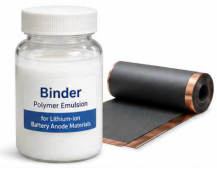
Binder for Lithium-ion Battery Anode Materials refers to functional polymer materials used in the preparation of anode slurry and anode electrodes for lithium-ion cells. They are typically supplied as water-based latexes, water-soluble polymers, solvent-based resins or modified polymer systems and are mixed with graphite, silicon-carbon, silicon-oxide, conductive additives and copper current collectors to form a stable anode electrode structure. Their core functions are to bind active material particles, conductive networks and copper foil together, while providing slurry dispersion stability, coating processability, electrode flexibility and structural retention during cycling. Major applications include EV batteries, energy storage batteries, consumer batteries, power tools and light mobility batteries.
Although the dosage of binder in the electrode is limited, it has a significant impact on peel strength, internal resistance, electrode density, powder shedding, cycle expansion and reliability across temperature ranges. As silicon-based anodes, fast-charging cells, thick electrodes and high-density electrode processes advance, anode binders are moving from conventional SBR/CMC systems toward high-strength, high-elasticity, waterborne, low-dosage, low-impedance and silicon-compatible functional binder systems.
Global Market Size and Expansion Path
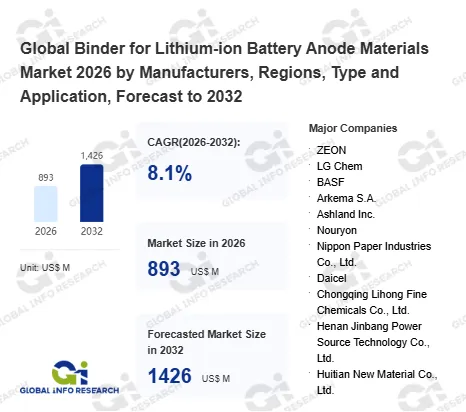
According to the latest report "Global Binder for Lithium-ion Battery Anode Materials Market 2026 by Manufacturers, Regions, Type and Application, Forecast to 2032" published by GIR (Global Info Research), the global Binder for Lithium-ion Battery Anode Materials market was valued at approximately USD 812 million in 2025 and is projected to reach USD 893 million in 2026. With a CAGR of 8.1% during the forecast period from 2026 to 2032, the market is expected to further expand to approximately USD 1426 million by 2032. This growth is driven by increasing market demand, evolving industry trends, and expanding application opportunities worldwide.
This market mainly covers SBR, CMC, PAA, PVDF and other modified polymer binders used in lithium-ion battery anode slurries, anode electrodes and anode material systems. Demand growth is primarily driven by rising power battery installations, large-scale energy storage deployment, higher penetration of silicon-based anodes, fast-charging cell upgrades, thick-electrode processing and the transition toward waterborne green manufacturing. On the supply side, leading manufacturers are investing in high-solid-content waterborne latexes, PAA/polyacrylate systems for silicon anodes, low-swelling high-adhesion materials, customer co-validation and localized production capacity. According to the IEA Global EV Outlook 2025, global electric car sales exceeded 17 million in 2024, while EV battery demand surpassed 950GWh, providing a solid industrial foundation for anode materials and related binders. Overall, the industry is shifting from general auxiliary material supply toward high-performance electrode functional materials, with future growth mainly coming from silicon-carbon/silicon-oxide anodes, high-rate power batteries, long-life energy storage batteries and localized battery supply chains in China, North America and Europe.
Competitive Landscape and Representative Manufacturers
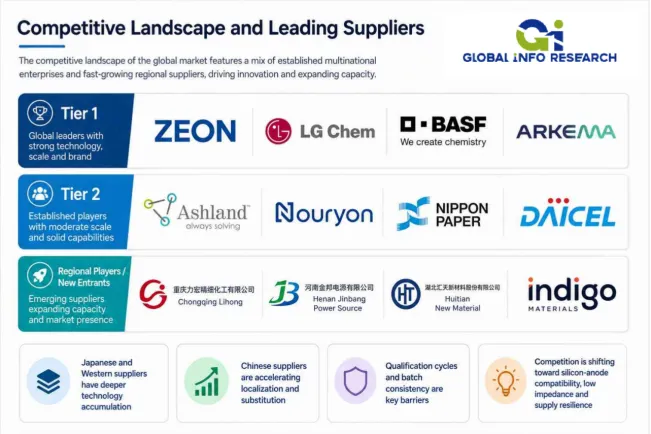
The global market is characterized by deep technology accumulation among Japanese and Western suppliers, accelerating substitution by Chinese suppliers, and strong qualification barriers from downstream battery customers. Representative manufacturers and suppliers include ZEON, LG Chem, BASF, Arkema S.A., Ashland Inc., Nouryon, Nippon Paper Industries Co., Ltd., Daicel, as well as Chinese fluorochemical and battery material suppliers such as Chongqing Lihong Fine Chemicals Co., Ltd., Henan Jinbang Power Source Technology Co., Ltd., Huitian New Material Co., Ltd., Sichuan Indigo Materials Technologies Group Co.,Ltd., Crystal Clear Elect, Blue Ocean and Black Stone Technology, Puyang Blue Star New Material Co., Ltd., Guangzhou Songbai Chemical Co., Ltd., Jinan Zhongbei Fine Chemical Co., Ltd., Pustar, and other local material companies, with the final complete list subject to the full Global Info Research report. Tier-one players typically have long-term battery customer qualifications, stable mass-supply capability, polymer modification know-how and global delivery capacity, enabling deep participation in formulation development with leading cell makers and anode material suppliers. Tier-two suppliers compete through selected material systems, regional supply capability and cost efficiency, while regional and new entrants are mainly breaking through via domestic substitution, silicon-anode-specific materials, waterborne systems and targeted customer projects. Future competition will shift from pure pricing to material system adaptability, suppression of silicon-related expansion, low-impedance/high-adhesion balance, qualification speed, batch consistency and regional supply resilience.
Product Types and Application Scenarios
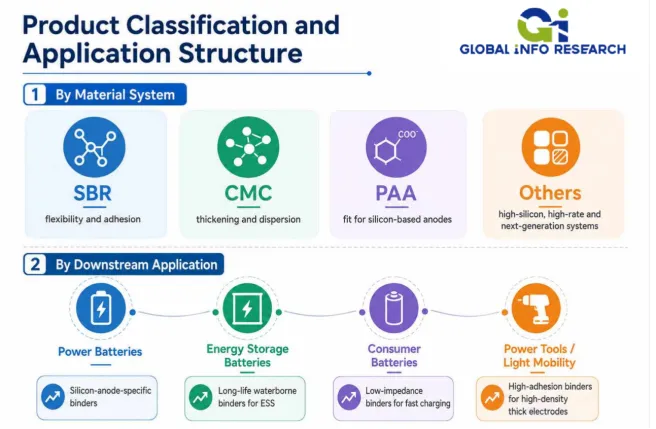
By material system, anode binders are mainly divided into SRB, CMC, PAA, and Others. SBR/CMC is a mature solution for graphite anodes and conventional waterborne anode slurry systems, where SBR provides flexibility and adhesion while CMC supports thickening, dispersion and slurry stability. PAA and modified polyacrylate systems are better suited for silicon-carbon, silicon-oxide and high-expansion anodes, improving electrode strength and buffering volume changes through hydrogen bonding, carboxyl interactions and network structures. Other modified systems include acrylic, alginate, polyimide, conductive and self-healing binders, mainly targeting high-silicon, high-rate or next-generation anode concepts. By downstream application, power batteries remain the largest demand source; energy storage batteries emphasize cost, life and batch stability; consumer batteries prioritize energy density, rate performance and miniaturization. Faster-growing areas include silicon-anode binders, low-impedance binders for fast-charging power cells, high-adhesion binders for high-density thick electrodes and long-life waterborne binders for energy storage batteries.
Regional Structure and Market Opportunities
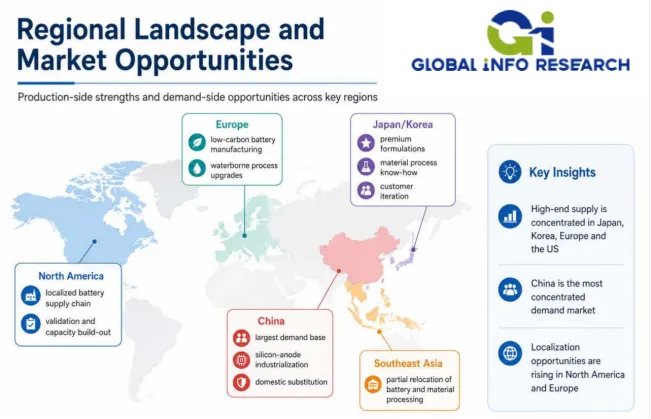
On the production side, high-end anode binder supply has historically been concentrated in Japan, Korea, Europe and the United States. Japanese suppliers have strong expertise in SBR waterborne binders, PVDF and fine polymer modification; European and US suppliers have advantages in PVDF, acrylic systems, waterborne dispersions and specialty polymer platforms; Chinese suppliers are rapidly improving supply capability on the back of battery manufacturing clusters, anode material capacity and local customer validation. On the demand side, China is the world’s largest power and energy storage battery production base and therefore the most concentrated market for anode binders. Korea, Japan and Europe are linked to premium power battery customers, consumer electronics and regional cell plants. North America is benefiting from local battery plant construction and supply-chain security policies, which are accelerating material localization and validation. Future regional opportunities will come from silicon-anode industrialization and domestic substitution in China, localized battery supply chains in North America, low-carbon battery manufacturing and waterborne processing in Europe, premium formulation upgrades in Japan and Korea, and selected battery and material processing capacity shifts toward Southeast Asia.
Supply Chain Structure and Value Distribution
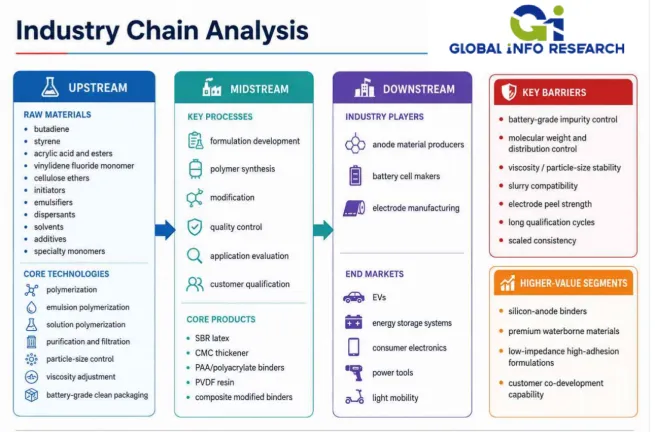
The upstream supply chain includes butadiene, styrene, acrylic acid and esters, vinylidene fluoride monomers, cellulose ethers, initiators, emulsifiers, dispersants, solvents, additives and specialty monomers, together with core technologies such as polymerization, emulsion polymerization, solution polymerization, purification, filtration, defoaming, particle-size control, viscosity adjustment and battery-grade clean packaging. Midstream activities include formulation development, polymer synthesis, modification, quality control, application testing and customer certification. Core products include SBR latexes, CMC thickeners, PAA and polyacrylate binders, PVDF resins and composite modified binders. Downstream customers include anode material producers, cell manufacturers and electrode manufacturing lines serving electric vehicles, energy storage systems, consumer electronics, power tools and light mobility. Key barriers include battery-grade impurity control, molecular weight distribution, viscosity and particle-size stability, slurry compatibility, electrode peel strength, cycle expansion control, long customer qualification and batch consistency. Higher-value areas are concentrated in binders for silicon-based anodes, premium waterborne materials, low-impedance high-adhesion formulations and co-development capability with customers. The supply chain will continue to evolve toward waterborne systems, lower VOCs, regional supply, multi-source raw material security and co-design with anode materials and cell processes.
Development Environment, Barriers and Outlook
Global electric vehicle, energy storage and battery manufacturing industries are driven by energy transition, carbon reduction, supply-chain security and local manufacturing policies. As a key auxiliary material in lithium-ion battery manufacturing, anode binders benefit from electrode material upgrades and greener production trends. However, the industry also faces technical barriers, qualification barriers, capital and capacity constraints, upstream monomer price fluctuations, high customer concentration, long formulation-switching cycles and uncertainty from alternative technologies. Anode binders must balance adhesion, dispersion, flexibility, ion transport, low resistance and electrolyte resistance at low addition levels. Entering the supply chain of leading battery customers typically requires material screening, slurry evaluation, electrode validation, cell testing, pilot production and long-term cycling reliability assessment.
In the next few years, the market will continue to benefit from power battery expansion, energy storage scale-up, silicon-anode penetration, fast-charging upgrades and the shift toward waterborne electrode manufacturing. Technology upgrades will focus on high-strength waterborne binders, PAA/composite network binders for silicon anodes, conductive or self-healing binders, low-dosage high-adhesion formulations and new materials compatible with dry or semi-dry electrode processes. Applications will extend from traditional graphite anodes toward silicon-carbon, silicon-oxide, high-density thick electrodes, fast-charging power cells and long-life energy storage batteries. Suppliers with polymer platforms, customer co-development capability, scaled production and global supply capacity will maintain advantages, while Chinese suppliers will continue to deepen domestic substitution through cost efficiency, rapid validation and proximity to battery customers.
Binder for Lithium-ion Battery Anode Materials Report Chapter Summary:
Chapter 1: Binder for Lithium-ion Battery Anode Materials Industry Definition and Market Overview
This chapter clearly defines the product definition, characteristics, and industry statistical scope of Binder for Lithium-ion Battery Anode Materials, systematically introduces its mainstream product classifications and key application areas, and presents the overall size and future outlook of the global market.
Chapter 2: In-depth Analysis of Core Binder for Lithium-ion Battery Anode Materials Companies (2021-2025)
This chapter focuses on the main players in the Binder for Lithium-ion Battery Anode Materials market. For each representative company, it not only introduces its basic overview, main business, and product portfolio, but also highlights its core operating data in the Binder for Lithium-ion Battery Anode Materials field, including sales volume, sales revenue, pricing strategies, and the latest development trends of the company from 2021 to 2025.
Chapter 3: Global Competitive Landscape Analysis (2021-2025)
This chapter examines the global Binder for Lithium-ion Battery Anode Materials competitive landscape from a macro perspective. By comparing the Binder for Lithium-ion Battery Anode Materials sales volume, pricing, revenue, and market share of major companies from 2021 to 2025, it quantitatively analyzes market concentration and interprets the competitive strategies and market position evolution of core manufacturers.
Chapter 4: Binder for Lithium-ion Battery Anode Materials Major Regional Market Size and Prospects (2021-2032)
This chapter conducts a regional-level analysis of the global Binder for Lithium-ion Battery Anode Materials core markets. It will present historical data on the Binder for Lithium-ion Battery Anode Materials market size (sales volume and revenue from 2021-2025) in major regions such as North America, Europe, and Asia Pacific, and provide market outlook forecasts for 2026-2032.
Chapter 5: Binder for Lithium-ion Battery Anode Materials Product Type Segmentation Market Forecast (2021-2032)
This chapter delves into the Binder for Lithium-ion Battery Anode Materials product structure. It will segment the Binder for Lithium-ion Battery Anode Materials market by different types (such as SRB、CMC、PAA、Others, etc.), and analyze in detail the historical market size of each segmented product category from 2021 to 2025 and the future growth trends from 2026 to 2032.
Chapter 6: Binder for Lithium-ion Battery Anode Materials Application Field Segmentation Market Forecast (2021-2032)
This chapter delves into the downstream application demand for Binder for Lithium-ion Battery Anode Materials. The market will be segmented by different application areas (such as Power Battery、Energy Storage Battery、Consumer Battery, etc.), presenting the historical market size for each area from 2021-2025 and future demand forecasts from 2026-2032.
Chapters 7-11: In-depth Analysis of Global Regional Markets (2021-2032)
This section is the core module of the Binder for Lithium-ion Battery Anode Materials report, providing an in-depth country/regional analysis across five major regions: North America, Europe, Asia Pacific, South America, and the Middle East & Africa. The chapter structure for each region is consistent:
Segmentation by Country/Region: Analysis of the market size and forecasts for major countries within the region from 2021-2032.
Segmentation by Product Type: Presentation of the market structure and development forecasts for different product types within the region from 2021-2032.
Segmentation by Application Area: Analysis of market demand and prospects for different application areas within the region from 2021-2032.
Chapter 12: Global Binder for Lithium-ion Battery Anode Materials Market Dynamics, Challenges, and Trends
This chapter aims to analyze the key internal and external factors affecting the development of the Binder for Lithium-ion Battery Anode Materials market. It systematically reviews the core drivers of Binder for Lithium-ion Battery Anode Materials market growth, the main obstacles and challenges faced, and assesses future product, technology, and market development trends.
Chapter 13: Binder for Lithium-ion Battery Anode Materials Industry Chain Structure Analysis
This chapter analyzes the entire industry chain ecosystem of the Binder for Lithium-ion Battery Anode Materials industry. From upstream raw material supply to midstream production and manufacturing, and then to downstream end-use applications, it analyzes the current status, cost structure, and collaborative relationships of each link.
Chapter 14: Sales Channel Model Research
This chapter focuses on the distribution channels of Binder for Lithium-ion Battery Anode Materials products. It analyzes the market share, advantages and disadvantages, and typical cases of mainstream sales channels, and explores the innovation and development trends of channel models.
Chapter 15: Research Conclusions and Strategic Recommendations
As a summary of the report, this chapter will distill the core findings and conclusions of the entire report and, based on a comprehensive understanding of the Binder for Lithium-ion Battery Anode Materials market, provide actionable strategic development recommendations for industry participants and potential entrants.
For more information, please refer to "Global Binder for Lithium-ion Battery Anode Materials Market 2026 by Manufacturers, Regions, Type and Application, Forecast to 2032". This report analyzes the supply and demand situation, development status, and changes in the industry, focusing on the development status of the industry, how to face the development challenges of the industry, industry development suggestions, industry competitiveness, and industry investment analysis and trend forecasts. The report also summarizes the overall development dynamics of the industry, including the impact of the latest US tariffs on the global supply chain, the supply relationship analysis of the industrial chain, and provides reference suggestions and specific solutions for the industry in terms of products.
Previous News:
Global Flue Gas Desulfurization Service Market Valued at US$7.15 Billion in 2026, Projected to Reach US$11.66 Billion by 2032 at 8.0% CAGR
Next News:
Global Automotive Microporous Lithium Battery Copper Foil Market Valued at US$87.46 Million in 2026, Projected to Reach US$931 Million by 2032 at 40.0% CAGR
The copyright of this article belongs to Global Info Research. Without the written authorization of our company, no organization or individual may reprint, quote, copy, adapt or use it for commercial purposes in any way. When authorized to use, the original source must be indicated as "Global Info Research" and the complete copyright information must be retained.
- We Provide Professional, Accurate Market Analysis to Help You Stay Ahead of Your Competition.Speak to our analyst >>

Our Clients
What We Can Provide?
With better results and higher quality products,Our professional reports can achieve four things:

Insight into the industry market information

Analyze market development needs

Prospects for future development

Develop industry investment strategy
- Digging deeper into global industry information and providing market strategies.Contact Us >>
- We Provide Professional, Accurate Market Analysis to Help You Stay Ahead of Your Competition.Speak to our analyst >>
Our Clients
What We Can Provide?
With better results and higher quality products,Our professional reports can achieve four things:
Insight into the industry market information
Analyze market development needs
Prospects for future development
Develop industry investment strategy
- Digging deeper into global industry information and providing market strategies.Contact Us >>