
Global Automotive Microporous Lithium Battery Copper Foil Market Valued at US$87.46 Million in 2026, Projected to Reach US$931 Million by 2032 at 40.0% CAGR
Published Date: Thursday,20 Aug,2026


 Automotive Microporous Lithium Battery Copper Foil
 Market Summary

Automotive Microporous Lithium Battery Copper Foil is a high-performance copper foil material used as the anode current collector in automotive power batteries, mainly serving lithium-ion batteries for passenger vehicles and commercial vehicles. Its core functions include electron conduction, active material support, and structural stabilization of the electrode. Compared with conventional lithium battery copper foil, microporous copper foil forms a controlled pore structure within the copper foil matrix, improving electrolyte wettability, interfacial bonding, and electrode stress release. This can help enhance rate performance, cycling stability, and safety.
Figure1. Global Automotive Microporous Lithium Battery Copper Foil Market Size (US$ Million), 2021-2032
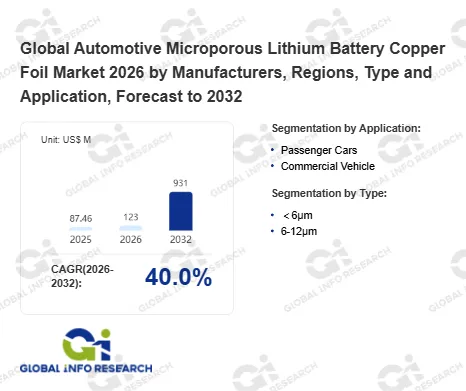
According to the latest report "Global Automotive Microporous Lithium Battery Copper Foil Market 2026 by Manufacturers, Regions, Type and Application, Forecast to 2032" published by GIR (Global Info Research), the global Automotive Microporous Lithium Battery Copper Foil market was valued at approximately USD 87.46 million and is projected to reach USD 931 million in the coming years, expanding at a CAGR of 40.0%. This growth reflects sustained market momentum and increasing opportunities driven by evolving industry demand and emerging application scenarios.
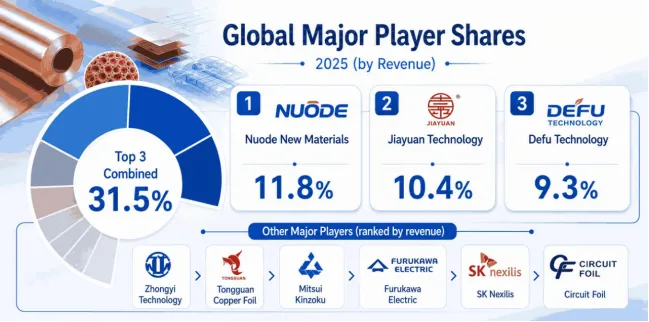
Figure2. Global Automotive Microporous Lithium Battery Copper Foil Top 9 Players Ranking and Market Share (Ranking is based on the revenue of 2025, continually updated)
Industrial Chain
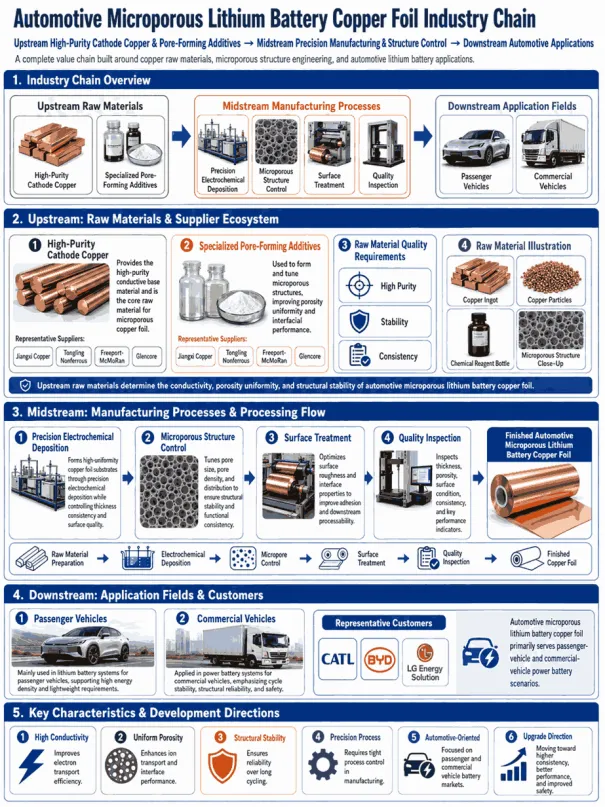
The upstream segment mainly consists of high-purity cathode copper and specialized pore-forming additives, with representative suppliers including Jiangxi Copper, Tongling Nonferrous Metals, Freeport-McMoRan, and Glencore. High-purity cathode copper determines the basic conductivity, metal purity, and electrochemical deposition stability of copper foil. Its impurity level, batch consistency, and supply stability directly affect foil thickness control, surface quality, and long-term battery reliability. Specialized pore-forming additives are critical auxiliary materials for forming the microporous structure, influencing pore size distribution, pore uniformity, and foil structural stability. As automotive power batteries move toward thinner copper foil, higher strength, and stronger interface compatibility, upstream competition is shifting from bulk copper resource supply to high purity, low impurity, stable mass supply, and functional additive formulation capability. Upstream companies with stable copper resources, refining capability, and battery material supply experience will maintain important positions in the high-end lithium battery copper foil value chain.
The midstream segment focuses on precision electrochemical deposition, microporous structure regulation, and surface treatment to achieve pore uniformity and structural stability. The core challenge at this stage is to maintain conductivity, mechanical strength, and ultra-thin processing capability while ensuring that the microporous structure remains stable, uniform, and repeatable in large-area continuous production. The electrochemical deposition process requires precise control of current density, electrolyte composition, temperature, flow rate, and roller surface conditions to avoid pinholes, wrinkles, uneven thickness, and surface defects. Microporous structure regulation requires a balance among pore size, porosity, and strength. Insufficient porosity weakens electrolyte wettability and interfacial bonding benefits, while excessive porosity may reduce foil strength and processing stability. Surface treatment determines compatibility between copper foil, anode active materials, binders, and electrolyte systems, directly affecting electrode peel strength, cycle life, and safety performance. Future midstream competitiveness will increasingly depend on continuous production stability, microporous structure consistency, ultra-thin foil yield, surface treatment formulations, and automotive-grade quality control.
The downstream segment mainly serves passenger vehicle and commercial vehicle applications, with core customers including CATL, BYD, and LG Energy Solution. Passenger vehicle power batteries require higher energy density, faster charging, longer cycle life, and stronger safety performance. Microporous lithium battery copper foil can improve electrode interface quality and electrolyte wettability, helping batteries maintain more stable performance under high-rate charge-discharge and long-cycle operating conditions. Commercial vehicle power batteries place greater emphasis on heavy-duty operation, long service life, durability, and operational safety. In electric buses, electric logistics vehicles, heavy trucks, and construction vehicles, current collector reliability directly affects the total lifecycle cost of the battery system. For battery companies such as CATL, BYD, and LG Energy Solution, the adoption of Automotive Microporous Lithium Battery Copper Foil can improve cell performance and support differentiation in fast charging, safety, and lifespan for premium power battery products. Downstream customers typically focus on foil thickness, pore uniformity, tensile strength, coating compatibility, batch consistency, supply stability, and cost competitiveness.
Figure3. Industry Chain
Influencing Factors
The industry’s growth is driven by rising new energy vehicle penetration, fast-charging power battery development, demand for higher energy density, and stricter battery safety standards. As the passenger vehicle market enters a more intense phase of range and charging-speed competition, battery companies need to optimize cathode and anode materials, electrolyte, separators, and current collectors simultaneously. As an upgraded anode current collector, microporous lithium battery copper foil can improve interface structure and electrolyte wetting efficiency, thereby enhancing overall battery performance. Commercial vehicle electrification also creates incremental demand, as high operating intensity and frequent charge-discharge cycles raise requirements for battery life and safety, accelerating the adoption of high-reliability copper foil materials. For material companies, the profitability of microporous lithium battery copper foil does not come only from foil thickness and capacity scale, but also from structural design, surface treatment, customer certification, and automotive-grade quality stability. Companies that can balance ultra-thin design, microporous uniformity, and high strength will be better positioned to enter leading power battery supply chains and secure stable orders.
The main restraints include high process difficulty, yield control pressure, strong cost sensitivity, and long customer qualification cycles. Although microporous structures can improve battery interface performance, they also increase the complexity of copper foil production. Pore size distribution, porosity, thickness uniformity, and surface condition must remain consistent during high-speed continuous production. If the microporous structure is unstable, it may lead to local strength reduction, uneven coating, electrode processing defects, or battery cycling performance fluctuations. Price volatility in high-purity cathode copper also affects copper foil profitability, while automotive power battery customers are highly sensitive to material costs. High-performance products must therefore prove that their performance improvement can justify additional cost. In addition, entering the supply chains of leading customers such as CATL, BYD, and LG Energy Solution usually requires long validation cycles, including material performance testing, electrode processing validation, cell testing, module safety testing, and batch stability evaluation. This raises the market entry threshold for new suppliers.
In the future, Automotive Microporous Lithium Battery Copper Foil will develop toward thinner specifications, higher strength, more uniform microporous structures, stronger interface compatibility, and lower total cost. On the product side, greater emphasis will be placed on the co-design of microporous structures with anode material systems, especially compatibility with silicon-carbon anodes, high-rate graphite anodes, and fast-charging battery systems. On the process side, high-precision electrochemical deposition, online porosity inspection, digital tension control, automated surface treatment, and clean production line upgrades will accelerate to improve yield and reduce unit manufacturing cost. On the application side, adoption will expand first in premium passenger vehicles, fast-charging power batteries, long-life commercial vehicle batteries, and high-safety battery systems. In the long run, Automotive Microporous Lithium Battery Copper Foil will evolve from a conventional current collector into an important functional material for power battery structural optimization and performance enhancement. Companies with upstream copper resource security, midstream precision manufacturing capability, and downstream leading-customer certification experience will be better positioned to win high-value orders and build sustainable profitability in the new energy vehicle materials market.
Automotive Microporous Lithium Battery Copper Foil Report Chapter Summary:
Chapter 1: Automotive Microporous Lithium Battery Copper Foil Industry Definition and Market Overview
This chapter clearly defines the product definition, characteristics, and industry statistical scope of Automotive Microporous Lithium Battery Copper Foil, systematically introduces its mainstream product classifications and key application areas, and presents the overall size and future outlook of the global market.
Chapter 2: In-depth Analysis of Core Automotive Microporous Lithium Battery Copper Foil Companies (2021-2025)
This chapter focuses on the main players in the Automotive Microporous Lithium Battery Copper Foil market. For each representative company, it not only introduces its basic overview, main business, and product portfolio, but also highlights its core operating data in the Automotive Microporous Lithium Battery Copper Foil field, including sales volume, sales revenue, pricing strategies, and the latest development trends of the company from 2021 to 2025.
Chapter 3: Global Competitive Landscape Analysis (2021-2025)
This chapter examines the global Automotive Microporous Lithium Battery Copper Foil competitive landscape from a macro perspective. By comparing the Automotive Microporous Lithium Battery Copper Foil sales volume, pricing, revenue, and market share of major companies from 2021 to 2025, it quantitatively analyzes market concentration and interprets the competitive strategies and market position evolution of core manufacturers.
Chapter 4: Automotive Microporous Lithium Battery Copper Foil Major Regional Market Size and Prospects (2021-2032)
This chapter conducts a regional-level analysis of the global Automotive Microporous Lithium Battery Copper Foil core markets. It will present historical data on the Automotive Microporous Lithium Battery Copper Foil market size (sales volume and revenue from 2021-2025) in major regions such as North America, Europe, and Asia Pacific, and provide market outlook forecasts for 2026-2032.
Chapter 5: Automotive Microporous Lithium Battery Copper Foil Product Type Segmentation Market Forecast (2021-2032)
This chapter delves into the Automotive Microporous Lithium Battery Copper Foil product structure. It will segment the Automotive Microporous Lithium Battery Copper Foil market by different types (such as <6μm、6-12μm, etc.), and analyze in detail the historical market size of each segmented product category from 2021 to 2025 and the future growth trends from 2026 to 2032.
Chapter 6: Automotive Microporous Lithium Battery Copper Foil Application Field Segmentation Market Forecast (2021-2032)
This chapter delves into the downstream application demand for Automotive Microporous Lithium Battery Copper Foil. The market will be segmented by different application areas (such as Passenger Cars、Commercial Vehicle, etc.), presenting the historical market size for each area from 2021-2025 and future demand forecasts from 2026-2032.
Chapters 7-11: In-depth Analysis of Global Regional Markets (2021-2032)
This section is the core module of the Automotive Microporous Lithium Battery Copper Foil report, providing an in-depth country/regional analysis across five major regions: North America, Europe, Asia Pacific, South America, and the Middle East & Africa. The chapter structure for each region is consistent:
Segmentation by Country/Region: Analysis of the market size and forecasts for major countries within the region from 2021-2032.
Segmentation by Product Type: Presentation of the market structure and development forecasts for different product types within the region from 2021-2032.
Segmentation by Application Area: Analysis of market demand and prospects for different application areas within the region from 2021-2032.
Chapter 12: Global Automotive Microporous Lithium Battery Copper Foil Market Dynamics, Challenges, and Trends
This chapter aims to analyze the key internal and external factors affecting the development of the Automotive Microporous Lithium Battery Copper Foil market. It systematically reviews the core drivers of Automotive Microporous Lithium Battery Copper Foil market growth, the main obstacles and challenges faced, and assesses future product, technology, and market development trends.
Chapter 13: Automotive Microporous Lithium Battery Copper Foil Industry Chain Structure Analysis
This chapter analyzes the entire industry chain ecosystem of the Automotive Microporous Lithium Battery Copper Foil industry. From upstream raw material supply to midstream production and manufacturing, and then to downstream end-use applications, it analyzes the current status, cost structure, and collaborative relationships of each link.
Chapter 14: Sales Channel Model Research
This chapter focuses on the distribution channels of Automotive Microporous Lithium Battery Copper Foil products. It analyzes the market share, advantages and disadvantages, and typical cases of mainstream sales channels, and explores the innovation and development trends of channel models.
Chapter 15: Research Conclusions and Strategic Recommendations
As a summary of the report, this chapter will distill the core findings and conclusions of the entire report and, based on a comprehensive understanding of the Automotive Microporous Lithium Battery Copper Foil market, provide actionable strategic development recommendations for industry participants and potential entrants.
For more information, please refer to "Global Automotive Microporous Lithium Battery Copper Foil Market 2026 by Manufacturers, Regions, Type and Application, Forecast to 2032". This report analyzes the supply and demand situation, development status, and changes in the industry, focusing on the development status of the industry, how to face the development challenges of the industry, industry development suggestions, industry competitiveness, and industry investment analysis and trend forecasts. The report also summarizes the overall development dynamics of the industry, including the impact of the latest US tariffs on the global supply chain, the supply relationship analysis of the industrial chain, and provides reference suggestions and specific solutions for the industry in terms of products.
Previous News:
Global Binder for Lithium-ion Battery Anode Materials Market Valued at US$893 Million in 2026, Projected to Reach US$1.43 Billion by 2032 at 8.1% CAGR
Next News:
Global Medical Grade All-in-One PC Market Valued at US$381 Million in 2026, Projected to Reach US$540 Million by 2032 at 5.0% CAGR
The copyright of this article belongs to Global Info Research. Without the written authorization of our company, no organization or individual may reprint, quote, copy, adapt or use it for commercial purposes in any way. When authorized to use, the original source must be indicated as "Global Info Research" and the complete copyright information must be retained.
- We Provide Professional, Accurate Market Analysis to Help You Stay Ahead of Your Competition.Speak to our analyst >>

Our Clients
What We Can Provide?
With better results and higher quality products,Our professional reports can achieve four things:

Insight into the industry market information

Analyze market development needs

Prospects for future development

Develop industry investment strategy
- Digging deeper into global industry information and providing market strategies.Contact Us >>
- We Provide Professional, Accurate Market Analysis to Help You Stay Ahead of Your Competition.Speak to our analyst >>
Our Clients
What We Can Provide?
With better results and higher quality products,Our professional reports can achieve four things:
Insight into the industry market information
Analyze market development needs
Prospects for future development
Develop industry investment strategy
- Digging deeper into global industry information and providing market strategies.Contact Us >>