
Flush Diaphragm Pressure Sensor Market 2026: An 8.1% CAGR Opens a USD 4,532 Million Growth Opportunity by 2032 as Hygiene and Automation Demand Accelerates
Published Date: Monday,09 Nov,2026


 Flush Diaphragm Pressure Sensor
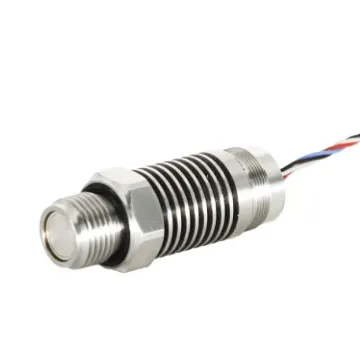 Flushing diaphragm pressure sensors are pressure detection devices employing a flush diaphragm structure with no dead angles and preventing clogging. They output stable electrical signals through diaphragm deformation and core conversion, making them suitable for measuring viscous, easily crystallizing, and highly corrosive media. The upstream core components are stainless steel diaphragms, MEMS cores, ASIC chips, and structural parts, with diaphragms and cores being the primary material consumption. Downstream, the sensors supply the food and pharmaceutical, chemical, new energy, automated production lines, and water treatment industries, with consumption concentrated in the food, pharmaceutical, and chemical sectors, forming a stable supply chain with equipment and engineering companies. Industry demand continues to grow with industrial intelligence and hygiene standard upgrades. High precision and domestic production bring business opportunities, and future development focuses on high precision, hygiene-grade upgrades, domestic substitution, digital intelligence, and expansion into new energy and biopharmaceutical applications.
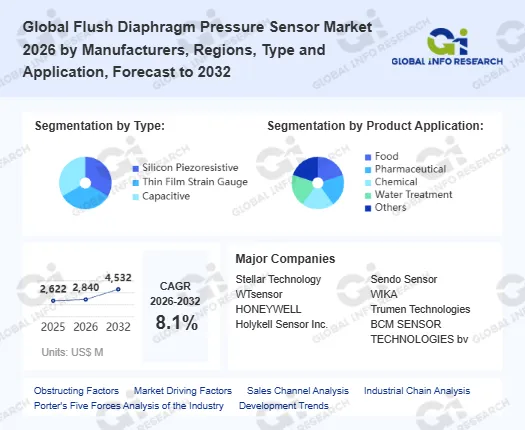
According to the latest report "Global Flush Diaphragm Pressure Sensor Market 2026 by Manufacturers, Regions, Type and Application, Forecast to 2032" published by GIR (Global Info Research), the global Flush Diaphragm Pressure Sensor market was valued at approximately USD 2622 million in 2025 and is projected to reach USD 2840 million in 2026. With a CAGR of 8.1% during the forecast period from 2026 to 2032, the market is expected to further expand to approximately USD 4532 million by 2032. This growth is driven by increasing market demand, evolving industry trends, and expanding application opportunities worldwide.
Currently, the market exhibits clear stratification. International brands dominate the high-end hygienic and high-precision markets, while domestic companies are rapidly penetrating mid-to-high-end scenarios thanks to their cost-effectiveness, delivery speed, and service advantages. Products are upgrading towards higher precision, wider temperature range, corrosion resistance, and digital intelligence. With the advancement of industrial intelligence, process standardization, and domestic substitution policies, companies with independent core components, special material diaphragms, and system integration capabilities are continuously strengthening their competitiveness, further expanding the market space.
In the long term, the industry will develop around four main directions: hygienic compliance upgrades, adaptation to special operating conditions, intelligent IoT integration, and the localization of core components. Market concentration will gradually increase, with manufacturers possessing deep technological and application-specific capabilities dominating the market.
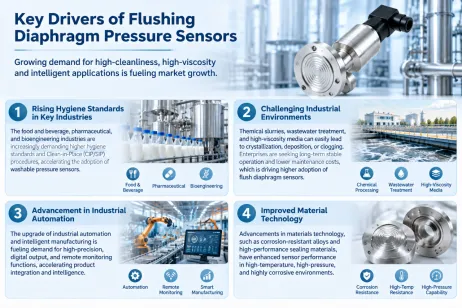
The development of flushing diaphragm pressure sensors is primarily driven by the increasing demand from downstream high-cleanliness and high-viscosity operating conditions.
First, the food and beverage, pharmaceutical, and bioengineering industries are continuously raising their requirements for hygiene standards and Clean-in-Place (CIP/SIP) procedures, accelerating the replacement of traditional pressure sensors with pressure measurement products featuring washable structures and dead-angle-free designs.
Second, the complex conditions of chemical slurries, wastewater treatment, and high-viscosity media easily lead to crystallization, deposition, or clogging. Enterprises are increasingly demanding long-term stable operation and reduced maintenance costs, driving up the penetration rate of washable products.
Third, the upgrading of industrial automation and intelligent manufacturing is driving increased demand for high-precision, digital output, and remote monitoring functions, leading to product integration and intelligence.
Simultaneously, advancements in materials technology (such as corrosion-resistant alloys and high-performance sealing materials) have improved the sensor's adaptability to high-temperature, high-pressure, and highly corrosive environments.
On the other hand, increasingly stringent industry standards and the arrival of equipment replacement cycles also provide incremental market opportunities. Overall, improved hygiene standards, expanded applications in complex working conditions, and intelligent upgrades are the core driving forces behind the continued development of washable diaphragm pressure sensors.
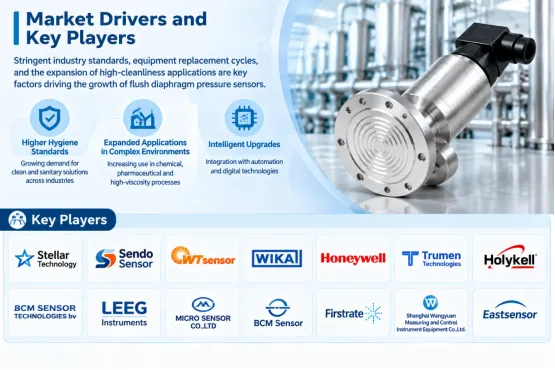
This report profiles key players of Flush Diaphragm Pressure Sensor such as Stellar Technology、Sendo Sensor、WTsensor、WIKA、HONEYWELL、Trumen Technologies、Holykell Sensor Inc.、BCM SENSOR TECHNOLOGIES bv、LEEG Instruments、MICRO SENSOR CO.,LTD、BCM Sensor、Firstrate、Shanghai Wangyuan Measuring and Control Instrument Equipment Co.,Ltd.、Eastsensor.
The diaphragm pressure sensor industry chain is a highly specialized, technology-intensive global collaborative system, mainly composed of three key links: upstream core component and material supply, midstream precision manufacturing and product integration, and downstream diversified application markets. The ultimate goal of this chain is to meet the stringent requirements of high-precision, high-reliability, and highly corrosion-resistant pressure measurement in fields such as petrochemicals, food and pharmaceuticals, and aerospace.
The upstream of the industry chain is the cornerstone of the entire industry, mainly involving the supply of sensitive elements (such as silicon, ceramics, sapphire, etc.), electronic components (such as ASIC chips, circuit boards), and structural materials (such as stainless steel, titanium, Hastelloy, etc.). Among these, the diaphragm, as the core pressure-sensing element of the sensor, has its material and manufacturing process directly determining the sensor's performance and stability. High-end sensors typically employ advanced MEMS (Micro-Electro-Mechanical Systems) technology to manufacture silicon-based or ceramic-based sensitive elements. In addition, the upstream also includes suppliers of special materials required for different application scenarios, such as stainless steel materials essential for the food and pharmaceutical industries, and titanium alloys and polymer materials required for ultra-high pressure or extreme corrosive environments. Suppliers in this segment are mostly companies that possess core material formulations and precision machining technologies. Their technological level and supply capabilities directly impact the product quality and technological iteration speed of midstream manufacturers.
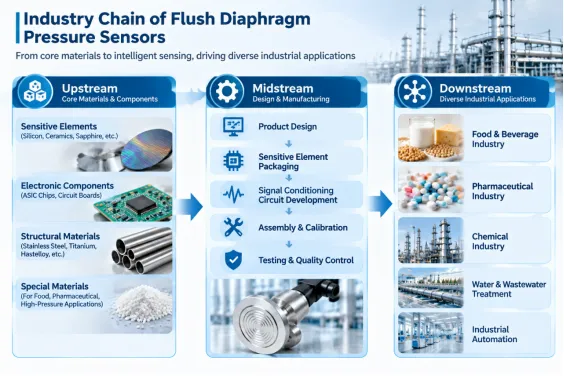
The midstream of the industry chain is the core, responsible for designing, manufacturing, and integrating upstream raw materials and components into fully functional flushing diaphragm pressure sensors or transmitters.
This segment encompasses product design, sensitive element packaging, signal conditioning circuit development, overall assembly, and rigorous calibration and testing processes. This field has high technological barriers, and the competitive landscape is internationally competitive. The global market is dominated by a group of international companies with deep technological accumulation and brand influence. These companies not only provide standardized sensor products but also offer customized solutions based on the specific needs of different industries (such as explosion-proof, hygienic design, and high-precision output). Furthermore, the midstream segment includes the development of software and hardware to provide intelligent functions such as digital output and wireless transmission for sensors, enabling seamless integration with Industry 4.0 and IoT systems.
The added value of the midstream segment is reflected in the product's measurement accuracy, long-term stability, environmental adaptability, and ability to pass various international certifications.
The downstream of the industry chain represents the final application market for the products, encompassing various industrial and scientific research fields requiring precise pressure measurement and control. Major application areas include:
Oil and Gas Industry: This is one of the largest application markets, where sensors are used in drilling, pipeline transportation, refining, and other processes, requiring reliable performance in high-pressure, flammable, explosive, and corrosive environments.
Food and Beverage Industry: The flush-mount membrane design facilitates cleaning and effectively prevents material blockage and bacterial growth, ensuring hygiene standards and product quality during pasteurization, fermentation, and bottling processes.
Pharmaceutical and Biotechnology Industry: Similar to the food industry, stringent GMP regulations require the use of sensors capable of withstanding steam sterilization and possessing aseptic connections in reactors, filters, and purified water systems.
Chemical Industry: Widely used in reaction vessels, storage tanks, and pipelines to monitor the pressure of corrosive or high-viscosity media.
Water and Wastewater Treatment: Used to monitor the pressure of pump stations, filtration systems, and pipelines to ensure the stable operation of water treatment processes.
Other sectors, including aerospace, automotive manufacturing, semiconductors, and medical equipment (such as ventilators and infusion pumps), place higher demands on sensor accuracy, response speed, and miniaturization. End-users' continuous pursuit of process automation, safety monitoring, and product quality is the core driving force behind the development of the entire industry chain.
The market competition landscape for flushing diaphragm pressure sensors exhibits the following characteristics:
From a segmented perspective, the flushing diaphragm pressure sensor market displays a clear tiered structure.
The first tier consists of international process instrument manufacturers. Leveraging mature sensor core technology, sanitary design experience, and a comprehensive global certification system, they occupy the high-end food, pharmaceutical, and fine chemical markets. Their products focus on high precision, high stability, and intelligent functions, resulting in strong customer loyalty.
The second tier comprises regional specialized instrument companies with certain customization capabilities and cost advantages. They hold a significant market share in mid-range industrial scenarios such as general chemicals, environmental protection, and wastewater treatment.
The third tier consists of small and medium-sized manufacturers, primarily focusing on standard models or low-pressure grade products. Market entry barriers are relatively low, and competition is mainly based on price, leading to significant product homogenization. In high-value-added product sectors such as those featuring online flushing interfaces, sanitary clamp connections, and integrated digital communication protocols, competition focuses more on technological iteration and application solution capabilities.
From an overall perspective, the industry exhibits a pattern of "concentration in the high-end and dispersion in the mid-to-low-end." The high-end market is dominated by a few companies with deep technological expertise, boasting relatively high gross margins and stable customer bases. The mid-to-low-end market has a larger number of participants, leading to fierce price competition and compressed profit margins. With increasingly stringent food safety regulations, upgraded pharmaceutical industry standards, and increased industrial automation, companies possessing capabilities in intelligent manufacturing, corrosion-resistant materials, and system integration will gradually expand their market share. Future market competition will shift from focusing on single-product performance to competing on comprehensive solutions, customization capabilities, and long-term service capabilities, potentially strengthening industry consolidation.
Flush Diaphragm Pressure Sensor Report Chapter Summary:
Chapter 1: Flush Diaphragm Pressure Sensor Industry Definition and Market Overview
This chapter clearly defines the product definition, characteristics, and industry statistical scope of Flush Diaphragm Pressure Sensor, systematically introduces its mainstream product classifications and key application areas, and presents the overall size and future outlook of the global market.
Chapter 2: In-depth Analysis of Core Flush Diaphragm Pressure Sensor Companies (2021-2025)
This chapter focuses on the main players in the Flush Diaphragm Pressure Sensor market. For each representative company, it not only introduces its basic overview, main business, and product portfolio, but also highlights its core operating data in the Flush Diaphragm Pressure Sensor field, including sales volume, sales revenue, pricing strategies, and the latest development trends of the company from 2021 to 2025.
Chapter 3: Global Competitive Landscape Analysis (2021-2025)
This chapter examines the global Flush Diaphragm Pressure Sensor competitive landscape from a macro perspective. By comparing the Flush Diaphragm Pressure Sensor sales volume, pricing, revenue, and market share of major companies from 2021 to 2025, it quantitatively analyzes market concentration and interprets the competitive strategies and market position evolution of core manufacturers.
Chapter 4: Flush Diaphragm Pressure Sensor Major Regional Market Size and Prospects (2021-2032)
This chapter conducts a regional-level analysis of the global Flush Diaphragm Pressure Sensor core markets. It will present historical data on the Flush Diaphragm Pressure Sensor market size (sales volume and revenue from 2021-2025) in major regions such as North America, Europe, and Asia Pacific, and provide market outlook forecasts for 2026-2032.
Chapter 5: Flush Diaphragm Pressure Sensor Product Type Segmentation Market Forecast (2021-2032)
This chapter delves into the Flush Diaphragm Pressure Sensor product structure. It will segment the Flush Diaphragm Pressure Sensor market by different types (such as Silicon Piezoresistive、Thin Film Strain Gauge、Capacitive, etc.), and analyze in detail the historical market size of each segmented product category from 2021 to 2025 and the future growth trends from 2026 to 2032.
Chapter 6: Flush Diaphragm Pressure Sensor Application Field Segmentation Market Forecast (2021-2032)
This chapter delves into the downstream application demand for Flush Diaphragm Pressure Sensor. The market will be segmented by different application areas (such as Food、Pharmaceutical、Chemical、Water Treatment、Others, etc.), presenting the historical market size for each area from 2021-2025 and future demand forecasts from 2026-2032.
Chapters 7-11: In-depth Analysis of Global Regional Markets (2021-2032)
This section is the core module of the Flush Diaphragm Pressure Sensor report, providing an in-depth country/regional analysis across five major regions: North America, Europe, Asia Pacific, South America, and the Middle East & Africa. The chapter structure for each region is consistent:
Segmentation by Country/Region: Analysis of the market size and forecasts for major countries within the region from 2021-2032.
Segmentation by Product Type: Presentation of the market structure and development forecasts for different product types within the region from 2021-2032.
Segmentation by Application Area: Analysis of market demand and prospects for different application areas within the region from 2021-2032.
Chapter 12: Global Flush Diaphragm Pressure Sensor Market Dynamics, Challenges, and Trends
This chapter aims to analyze the key internal and external factors affecting the development of the Flush Diaphragm Pressure Sensor market. It systematically reviews the core drivers of Flush Diaphragm Pressure Sensor market growth, the main obstacles and challenges faced, and assesses future product, technology, and market development trends.
Chapter 13: Flush Diaphragm Pressure Sensor Industry Chain Structure Analysis
This chapter analyzes the entire industry chain ecosystem of the Flush Diaphragm Pressure Sensor industry. From upstream raw material supply to midstream production and manufacturing, and then to downstream end-use applications, it analyzes the current status, cost structure, and collaborative relationships of each link.
Chapter 14: Sales Channel Model Research
This chapter focuses on the distribution channels of Flush Diaphragm Pressure Sensor products. It analyzes the market share, advantages and disadvantages, and typical cases of mainstream sales channels, and explores the innovation and development trends of channel models.
Chapter 15: Research Conclusions and Strategic Recommendations
As a summary of the report, this chapter will distill the core findings and conclusions of the entire report and, based on a comprehensive understanding of the Flush Diaphragm Pressure Sensor market, provide actionable strategic development recommendations for industry participants and potential entrants.
For more information, please refer to "Global Flush Diaphragm Pressure Sensor Market 2026 by Manufacturers, Regions, Type and Application, Forecast to 2032". This report analyzes the supply and demand situation, development status, and changes in the industry, focusing on the development status of the industry, how to face the development challenges of the industry, industry development suggestions, industry competitiveness, and industry investment analysis and trend forecasts. The report also summarizes the overall development dynamics of the industry, including the impact of the latest US tariffs on the global supply chain, the supply relationship analysis of the industrial chain, and provides reference suggestions and specific solutions for the industry in terms of products.
Previous News:
Ship Condition Monitoring Tool Market 2026: 7.9% CAGR Signals Growth Opportunity Toward USD 1,373 Million by 2032
Next News:
Home Decoration Adhesive Market 2026: A 3.4% CAGR Points to a USD 1,563 Million Opportunity by 2032 as Renovation Demand and Green Product Upgrades Accelerate
The copyright of this article belongs to Global Info Research. Without the written authorization of our company, no organization or individual may reprint, quote, copy, adapt or use it for commercial purposes in any way. When authorized to use, the original source must be indicated as "Global Info Research" and the complete copyright information must be retained.
- We Provide Professional, Accurate Market Analysis to Help You Stay Ahead of Your Competition.Speak to our analyst >>

Our Clients
What We Can Provide?
With better results and higher quality products,Our professional reports can achieve four things:

Insight into the industry market information

Analyze market development needs

Prospects for future development

Develop industry investment strategy
- Digging deeper into global industry information and providing market strategies.Contact Us >>
- We Provide Professional, Accurate Market Analysis to Help You Stay Ahead of Your Competition.Speak to our analyst >>
Our Clients
What We Can Provide?
With better results and higher quality products,Our professional reports can achieve four things:
Insight into the industry market information
Analyze market development needs
Prospects for future development
Develop industry investment strategy
- Digging deeper into global industry information and providing market strategies.Contact Us >>