
Walk-behind Electric Pallet Stacker Market 2026: A 6.9% CAGR Points to a USD 1,360 Million Opportunity by 2032 as Warehouse Automation and Labor Costs Accelerate the Shift from Manual Hydraulic Stackers
Published Date: Tuesday,10 Nov,2026


 Walk-behind Electric Pallet Stacker
 Market Summary
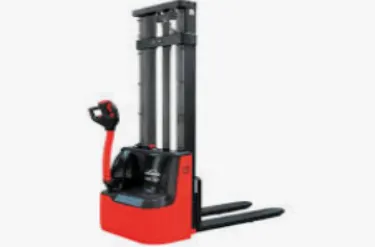
The Walk-behind Electric Pallet Stacker is a type of warehouse vehicle powered by a battery and operated by a person either walking behind or standing on a rear platform; it is controlled via a handle for travel and lifting, and is designed specifically for the short-distance transport and stacking of palletized goods in warehouses, workshops, and supermarkets. Its core mechanism is a hydraulic lifting mast that raises the forks along fixed rails to a predetermined height (typically 1.6 to 5.5 meters), enabling the stacking of goods layer by layer. Characterized by a compact body and agile steering, and featuring a rated load capacity typically ranging from 1.0 to 2.0 tons, the vehicle utilizes electric drive for movement and hydraulics for lifting. Integrating self-propelled travel, loading/unloading, and stacking capabilities, it serves as an ideal replacement for manual hydraulic stackers in operations requiring frequent vertical stacking.
The market for Walk-behind Electric Pallet Stacker is benefiting from the ongoing global upgrade of warehouse and logistics automation and the growing corporate need to reduce costs and improve efficiency. Serving as a crucial link between manual handling equipment and large forklifts, these stackers offer a blend of moderate costs, operational flexibility, ease of maintenance, and excellent spatial adaptability. Consequently, they are widely used in warehousing and distribution centers, manufacturing plants, retail warehouses, cold chain logistics, and the food and pharmaceutical industries. Driven by rising labor costs and the demand for higher handling efficiency, the shift from traditional manual hydraulic stackers to electric models has become a key industry trend, providing steady momentum for market growth.
In terms of market demand, small and medium-sized warehouses and manufacturing enterprises remain the primary buyers of Walk-behind Electric Pallet Stacker. Compared to counterbalanced and reach trucks, these pedestrian-operated units entail lower procurement and operating costs, making them better suited for low-to-medium intensity handling and stacking tasks. The rapid expansion of e-commerce, community delivery services, third-party logistics, and chain retail has led to an increase in total warehouse space, thereby driving up demand for this type of equipment. Meanwhile, the stringent requirements for cleanliness, safety, and flexible handling in the food and beverage, pharmaceutical, and cold chain logistics sectors have led to increased market penetration of electric stackers in these industries.
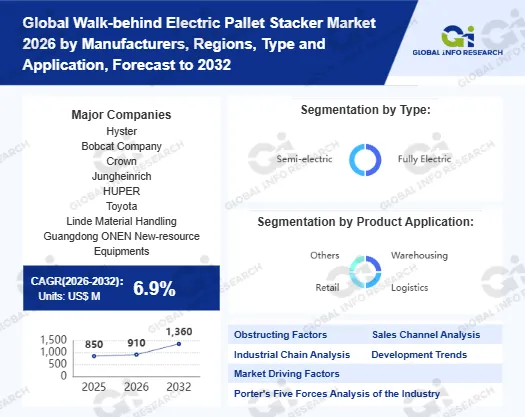
According to the latest report "Global Walk-behind Electric Pallet Stacker Market 2026 by Manufacturers, Regions, Type and Application, Forecast to 2032" published by GIR (Global Info Research), the global Walk-behind Electric Pallet Stacker market was valued at approximately USD 850 million in 2025 and is projected to reach USD 910 million in 2026. With a CAGR of 6.9% during the forecast period from 2026 to 2032, the market is expected to further expand to approximately USD 1360 million by 2032. This growth is driven by increasing market demand, evolving industry trends, and expanding application opportunities worldwide.
Technologically, Walk-behind Electric Pallet Stacker are evolving toward lithium-ion power, intelligent features, and higher efficiency. Lithium-ion batteries are rapidly replacing traditional lead-acid batteries, with end-users widely recognizing their advantages—namely fast charging, low maintenance costs, and long service life. Concurrently, features such as electronic steering systems, smart display terminals, battery management systems (BMS), and remote monitoring capabilities are becoming standard in mid-to-high-end models. Leading manufacturers are also integrating IoT technology and fleet management systems into equipment management processes to boost utilization rates and operational efficiency.
Overall, Walk-behind Electric Pallet Stacker represent one of the products with the broadest demand base in the warehouse handling equipment market; growth is primarily fueled by the expansion of warehousing and logistics, the transition to electric power, and automation upgrades among small and medium-sized enterprises. Looking ahead, as e-commerce, cold chain logistics, smart warehousing, and the digitalization of manufacturing continue to advance, the industry's development will increasingly focus on products characterized by lithium-ion power, high reliability, and intelligent management capabilities. Enterprises possessing large-scale manufacturing capabilities, advantages in electronic control technology, and comprehensive service systems are poised to secure greater room for growth in future market competition.
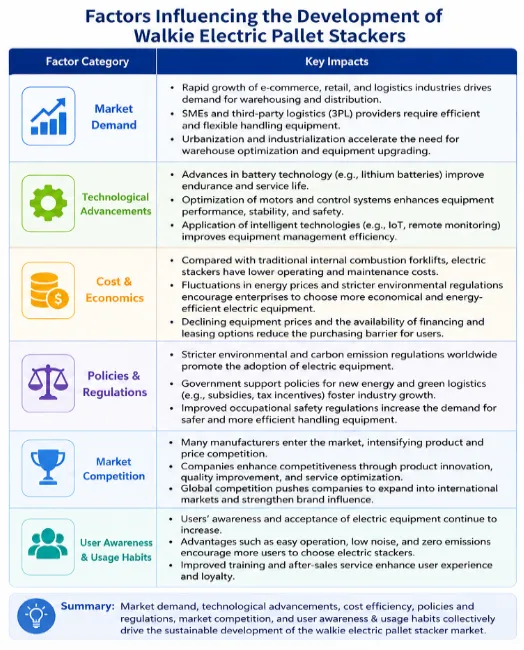
The development of Walk-behind Electric Pallet Stacker is influenced by various factors.
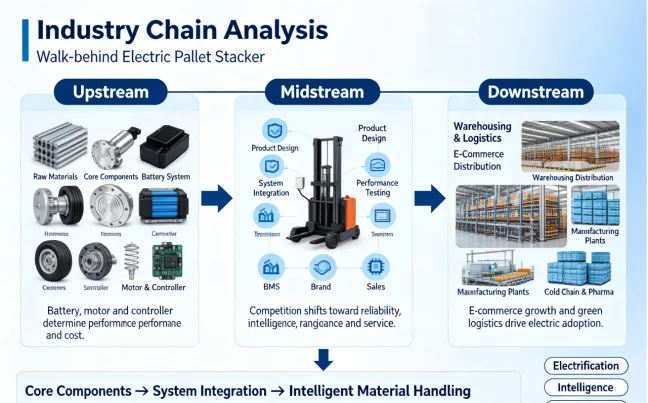
The industry chain for Walk-behind Electric Pallet Stacker comprises three main segments: upstream supply of raw materials and core components, midstream manufacturing and system integration, and downstream application markets. The upstream sector primarily involves basic materials—such as steel, aluminum alloys, engineering plastics, and rubber products—and suppliers of core components, including drive motors, hydraulic systems, batteries (lead-acid or lithium-ion), controllers, sensors, wheels, bearings, and electronic components. Among these, battery systems, motors, and controllers are critical factors determining product performance and cost. Driven by the maturation of lithium-ion battery technology and upgrades to electronic control systems, the upstream supply chain is evolving toward high energy efficiency, lightweight design, and intelligent functionality.
The midstream sector consists of manufacturers responsible for product design, component procurement, assembly, performance testing, and brand sales. By integrating drive systems, hydraulic lifting systems, battery management systems (BMS), and intelligent control modules, manufacturers create product series tailored to various load capacities, lifting heights, and application scenarios. Industry competition is shifting from a focus on price alone to product reliability, intelligence levels, battery range, and after-sales service capabilities, compelling enterprises to increase investment in R&D and product upgrades.
Downstream application markets encompass sectors such as warehousing and logistics centers, e-commerce distribution centers, manufacturing plants, retail supermarkets, cold chain logistics, pharmaceutical warehousing, and third-party logistics (3PL) providers. Market demand for Walk-behind Electric Pallet Stacker continues to grow, driven by the rapid expansion of global e-commerce, the upgrade to automated warehousing, and the increasing corporate need for optimized material handling efficiency and operational costs. Simultaneously, trends toward green logistics and low-carbon transport are accelerating the replacement of traditional internal combustion forklifts and manual handling equipment with electric models; this expands the scope of application and drives the entire industry chain toward intelligence, electrification, and digitalization.
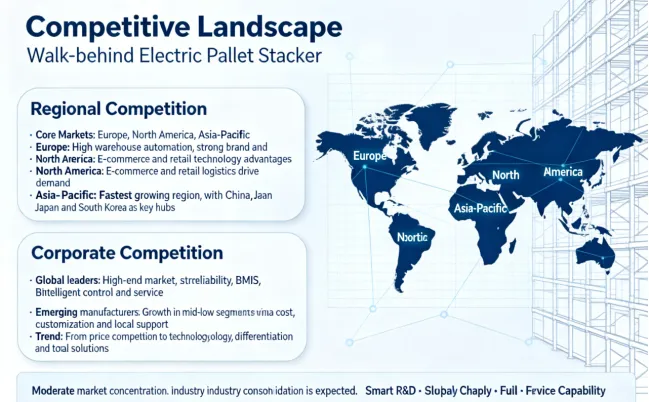
The competitive landscape for Walk-behind Electric Pallet Stacker is characterized by the following:
In terms of regional competition, Europe, North America, and the Asia-Pacific region constitute the core competitive markets for Walk-behind Electric Pallet Stacker globally. The European market, having started earlier, boasts a high level of warehouse automation and steady demand for electric material handling equipment, thereby establishing strong technological and brand advantages. Driven by the expansion of e-commerce, retail logistics, and industrial warehouse upgrades, the North American market sees continuous growth in demand for high-efficiency, low-maintenance equipment. Meanwhile, the Asia-Pacific region has emerged as the fastest-growing market globally, fueled by manufacturing expansion, logistics infrastructure development, and the rapid growth of the e-commerce sector; China, Japan, and South Korea have become key hubs for both production and consumption.
In terms of corporate competition, the market landscape is characterized by the coexistence of international brands and regional manufacturers. Leading international companies dominate the high-end market by leveraging their brand influence, accumulated technical expertise, and global sales networks, maintaining distinct advantages in product reliability, intelligent control systems, battery management systems, and after-sales service. Conversely, manufacturers from China and other emerging markets are steadily expanding their share in the low-to-mid-range and growth segments by capitalizing on cost advantages, rapid customization capabilities, and localized services. As lithium-ion battery technology becomes widespread, smart warehouse construction accelerates, and customer demands for operational efficiency rise, competition is shifting from a focus on price to a contest of technological innovation, product differentiation, and the ability to provide comprehensive solutions.
Overall, the global market for Walk-behind Electric Pallet Stacker is characterized by robust competition and moderate market concentration. While leading enterprises command significant market share through their brand, technology, and distribution channels, the market still hosts a large number of regional manufacturers and specialized suppliers. Looking ahead, as demand for warehouse automation, green logistics, and digital management continues to rise, industry concentration is expected to increase; companies possessing capabilities in intelligent product R&D, global supply chain management, and comprehensive service systems will secure a greater competitive advantage.
Walk-behind Electric Pallet Stacker Report Chapter Summary:
Chapter 1: Walk-behind Electric Pallet Stacker Industry Definition and Market Overview
This chapter clearly defines the product definition, characteristics, and industry statistical scope of Walk-behind Electric Pallet Stacker, systematically introduces its mainstream product classifications and key application areas, and presents the overall size and future outlook of the global market.
Chapter 2: In-depth Analysis of Core Walk-behind Electric Pallet Stacker Companies (2021-2025)
This chapter focuses on the main players in the Walk-behind Electric Pallet Stacker market. For each representative company, it not only introduces its basic overview, main business, and product portfolio, but also highlights its core operating data in the Walk-behind Electric Pallet Stacker field, including sales volume, sales revenue, pricing strategies, and the latest development trends of the company from 2021 to 2025.
Chapter 3: Global Competitive Landscape Analysis (2021-2025)
This chapter examines the global Walk-behind Electric Pallet Stacker competitive landscape from a macro perspective. By comparing the Walk-behind Electric Pallet Stacker sales volume, pricing, revenue, and market share of major companies from 2021 to 2025, it quantitatively analyzes market concentration and interprets the competitive strategies and market position evolution of core manufacturers.
Chapter 4: Walk-behind Electric Pallet Stacker Major Regional Market Size and Prospects (2021-2032)
This chapter conducts a regional-level analysis of the global Walk-behind Electric Pallet Stacker core markets. It will present historical data on the Walk-behind Electric Pallet Stacker market size (sales volume and revenue from 2021-2025) in major regions such as North America, Europe, and Asia Pacific, and provide market outlook forecasts for 2026-2032.
Chapter 5: Walk-behind Electric Pallet Stacker Product Type Segmentation Market Forecast (2021-2032)
This chapter delves into the Walk-behind Electric Pallet Stacker product structure. It will segment the Walk-behind Electric Pallet Stacker market by different types (such as Fully Electric、Semi-electric, etc.), and analyze in detail the historical market size of each segmented product category from 2021 to 2025 and the future growth trends from 2026 to 2032.
Chapter 6: Walk-behind Electric Pallet Stacker Application Field Segmentation Market Forecast (2021-2032)
This chapter delves into the downstream application demand for Walk-behind Electric Pallet Stacker. The market will be segmented by different application areas (such as Warehousing、Logistics、Retail、Others, etc.), presenting the historical market size for each area from 2021-2025 and future demand forecasts from 2026-2032.
Chapters 7-11: In-depth Analysis of Global Regional Markets (2021-2032)
This section is the core module of the Walk-behind Electric Pallet Stacker report, providing an in-depth country/regional analysis across five major regions: North America, Europe, Asia Pacific, South America, and the Middle East & Africa. The chapter structure for each region is consistent:
Segmentation by Country/Region: Analysis of the market size and forecasts for major countries within the region from 2021-2032.
Segmentation by Product Type: Presentation of the market structure and development forecasts for different product types within the region from 2021-2032.
Segmentation by Application Area: Analysis of market demand and prospects for different application areas within the region from 2021-2032.
Chapter 12: Global Walk-behind Electric Pallet Stacker Market Dynamics, Challenges, and Trends
This chapter aims to analyze the key internal and external factors affecting the development of the Walk-behind Electric Pallet Stacker market. It systematically reviews the core drivers of Walk-behind Electric Pallet Stacker market growth, the main obstacles and challenges faced, and assesses future product, technology, and market development trends.
Chapter 13: Walk-behind Electric Pallet Stacker Industry Chain Structure Analysis
This chapter analyzes the entire industry chain ecosystem of the Walk-behind Electric Pallet Stacker industry. From upstream raw material supply to midstream production and manufacturing, and then to downstream end-use applications, it analyzes the current status, cost structure, and collaborative relationships of each link.
Chapter 14: Sales Channel Model Research
This chapter focuses on the distribution channels of Walk-behind Electric Pallet Stacker products. It analyzes the market share, advantages and disadvantages, and typical cases of mainstream sales channels, and explores the innovation and development trends of channel models.
Chapter 15: Research Conclusions and Strategic Recommendations
As a summary of the report, this chapter will distill the core findings and conclusions of the entire report and, based on a comprehensive understanding of the Walk-behind Electric Pallet Stacker market, provide actionable strategic development recommendations for industry participants and potential entrants.
For more information, please refer to "Global Walk-behind Electric Pallet Stacker Market 2026 by Manufacturers, Regions, Type and Application, Forecast to 2032". This report analyzes the supply and demand situation, development status, and changes in the industry, focusing on the development status of the industry, how to face the development challenges of the industry, industry development suggestions, industry competitiveness, and industry investment analysis and trend forecasts. The report also summarizes the overall development dynamics of the industry, including the impact of the latest US tariffs on the global supply chain, the supply relationship analysis of the industrial chain, and provides reference suggestions and specific solutions for the industry in terms of products.
Previous News:
Global Governed Enterprise Architecture Scenario Sandbox Market Is Projected to Reach USD 1,963 Million by 2032, Expanding at a 15.3% CAGR During the 2026–2032 Forecast Period
Next News:
Wheel Diameter Measuring Instrument Market 2026: A 5.0% CAGR Points to a USD 3,294 Million Opportunity by 2032 as Rail Safety Standards and Automated Inspection Demand Rise
The copyright of this article belongs to Global Info Research. Without the written authorization of our company, no organization or individual may reprint, quote, copy, adapt or use it for commercial purposes in any way. When authorized to use, the original source must be indicated as "Global Info Research" and the complete copyright information must be retained.
- We Provide Professional, Accurate Market Analysis to Help You Stay Ahead of Your Competition.Speak to our analyst >>

Our Clients
What We Can Provide?
With better results and higher quality products,Our professional reports can achieve four things:

Insight into the industry market information

Analyze market development needs

Prospects for future development

Develop industry investment strategy
- Digging deeper into global industry information and providing market strategies.Contact Us >>
- We Provide Professional, Accurate Market Analysis to Help You Stay Ahead of Your Competition.Speak to our analyst >>
Our Clients
What We Can Provide?
With better results and higher quality products,Our professional reports can achieve four things:
Insight into the industry market information
Analyze market development needs
Prospects for future development
Develop industry investment strategy
- Digging deeper into global industry information and providing market strategies.Contact Us >>