
2026 Modular Sodium-Ion Battery Pack Outlook: 28.8% CAGR Forecast as Cylindrical, Prismatic and Pouch Modular Designs Scale Toward USD 4,199 Million by 2032
Published Date: Wednesday,18 Nov,2026


 Modular Sodium-Ion Battery Pack
 Market Summary
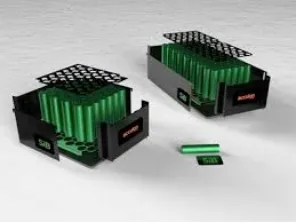
The industrial chain of Modular Sodium-Ion Battery Packs covers upstream sodium salts, cathode materials, anode materials, electrolytes, separators, current collectors, cell casings, and electronic components. The midstream includes cell manufacturing, module assembly, battery management system integration, thermal management, enclosure design, safety testing, and pack certification. Downstream applications mainly include residential energy storage, commercial and industrial storage, telecom backup power, low-speed electric vehicles, two-wheelers, forklifts, and renewable energy storage systems. Related services include system design, installation, monitoring, maintenance, recycling, and customization for voltage, capacity, safety, and cycle-life requirements.
Global Modular Sodium-Ion Battery Pack Market Size (US$ Million), 2021-2032
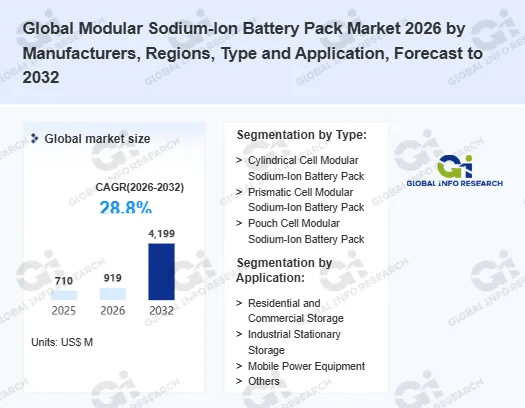
According to the latest report published "Global Modular Sodium-Ion Battery Pack Market 2026 by Manufacturers, Regions, Type and Application, Forecast to 2032" by GIR (Global Info Research), the global Modular Sodium-Ion Battery Pack market was valued at approximately USD 710 million in 2025 and is projected to reach USD 919 million in 2026. With a CAGR of 28.8% during the forecast period from 2026 to 2032, the market is expected to further expand to approximately USD 4199 million by 2032. This growth is driven by increasing market demand, evolving industry trends, and expanding application opportunities worldwide.
Global Modular Sodium-Ion Battery Pack Top 10 Players Ranking and Market Share
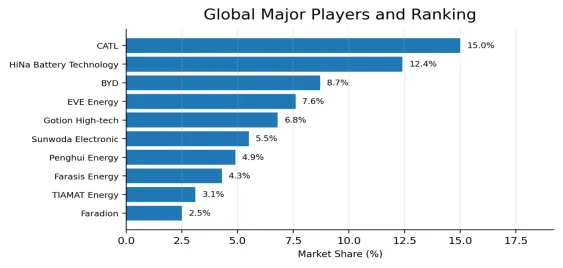
In 2026, the global top 10 players revenue share was approximately 70.8%.
A modular sodium-ion battery pack is a rechargeable energy storage unit built from sodium-ion cells, battery management electronics, thermal structures, mechanical enclosures and standardized electrical interfaces. Unlike lithium-ion packs, it uses sodium-based cathode and anode chemistries, which can reduce dependence on lithium, nickel and cobalt while offering good low-temperature performance, safety characteristics and cost potential. The modular design allows cells and sub-packs to be combined into scalable blocks for stationary energy storage, low-speed mobility, telecom backup power, industrial equipment and selected transportation uses. The market scope mainly covers packaged sodium-ion battery modules and packs sold as integrated power units, rather than individual cells, raw cathode materials or complete energy storage stations. Key performance requirements include cycle life, energy density, power output, thermal stability, state-of-charge accuracy, protection functions and compatibility with inverters or vehicle control systems. As commercialization accelerates, modular pack design is becoming important for manufacturability, safety certification and flexible downstream integration.
Competitive Landscape
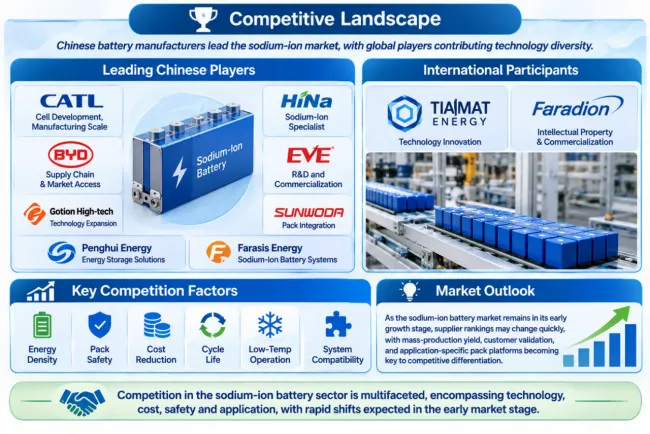
The competitive landscape is led by Chinese battery manufacturers that are moving sodium-ion technology from pilot production toward early commercial deployment. CATL has strong advantages in cell development, manufacturing scale, customer access and system integration, while HiNa Battery Technology is recognized as a focused sodium-ion specialist with early projects in energy storage and mobility applications. BYD, EVE Energy, Gotion High-tech, Sunwoda Electronic, Penghui Energy and Farasis Energy are expanding sodium-ion research and pack-level capabilities by leveraging their lithium-ion production experience, supply chains and relationships with energy storage and vehicle customers. European players such as TIAMAT Energy and Faradion contribute technology diversity, intellectual property and regional commercialization potential. Competition is not only based on energy density, but also on pack safety, cost reduction, cycle life, charging behavior, low-temperature operation and system compatibility. Because the market is still in an early growth stage, supplier rankings may change quickly as mass-production yield, customer validation and application-specific pack platforms become more important.
Main Type
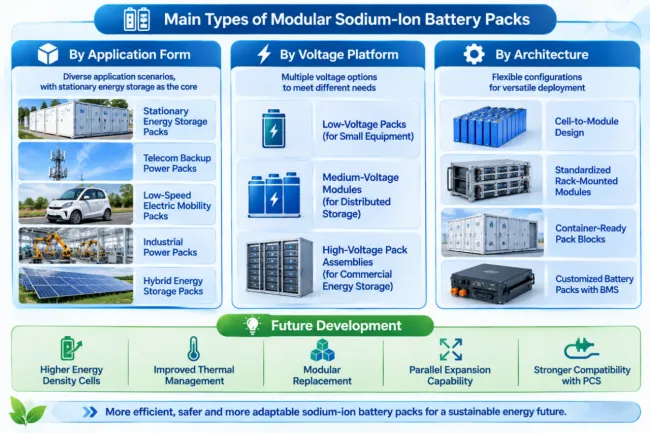
Main product types can be segmented by application form, voltage platform and pack architecture. By application form, modular sodium-ion battery packs include stationary energy storage packs, telecom backup power packs, low-speed electric mobility packs, industrial power packs and hybrid energy storage packs used with solar or grid-support systems. Stationary energy storage is currently the most important direction because sodium-ion technology is well suited to cost-sensitive and safety-oriented applications where energy density is less critical than lifecycle cost, temperature tolerance and supply security. By voltage platform, products may include low-voltage packs for small equipment, medium-voltage modules for distributed storage cabinets and higher-voltage pack assemblies for commercial energy storage systems. By architecture, suppliers provide cell-to-module designs, standardized rack-mounted modules, container-ready pack blocks and customized battery packs with integrated battery management systems. Future type differentiation will focus on higher energy density cells, improved thermal management, modular replacement, parallel expansion capability and stronger compatibility with power conversion systems.
Regional Perspective
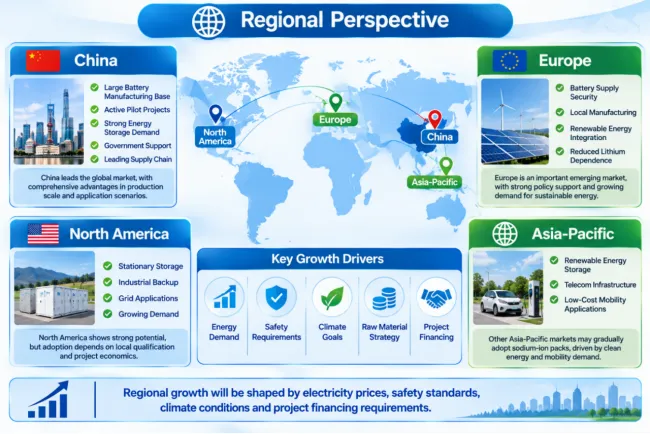
China is the leading regional market for modular sodium-ion battery packs, supported by a large battery manufacturing base, active pilot projects, energy storage demand, government interest in alternative battery chemistries and strong participation from major domestic cell and pack suppliers. The country has advantages in supply chain coordination, production scale and rapid application testing across energy storage, telecom and mobility scenarios. Europe is an important emerging market because of its focus on battery supply security, local manufacturing, renewable energy integration and reduced dependence on critical lithium resources. Companies such as TIAMAT Energy and Faradion support regional technology development, although commercial scale remains smaller than in China. North America has potential in stationary storage, industrial backup and grid applications, but adoption depends on local qualification, bankability and project economics. Other Asia-Pacific markets may gradually adopt sodium-ion packs through renewable energy storage, telecom infrastructure and low-cost mobility applications. Regional growth will be shaped by electricity prices, safety standards, climate conditions, raw material strategy and project financing requirements.
Market Drivers
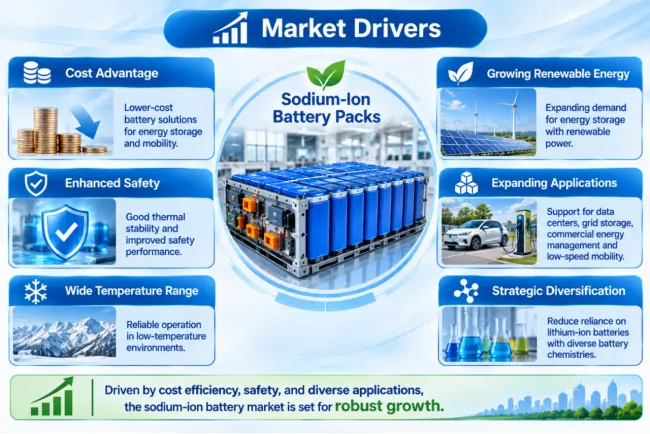
Market growth is driven by the need for lower-cost, safer and resource-diverse battery solutions in energy storage and selected mobility applications. Rapid expansion of renewable power creates demand for batteries that can be deployed at scale without excessive exposure to lithium price volatility. Sodium-ion technology benefits from abundant raw material availability, good thermal stability and strong performance potential in low-temperature environments, which makes it attractive for distributed storage, telecom backup and harsh-climate applications. The growth of data centers, grid-side storage, commercial energy management and low-speed electric transportation also supports demand for modular battery packs that can be configured flexibly. In China, major battery manufacturers are accelerating pilot production and customer validation, which improves market confidence and supply availability. Another driver is the strategic need to diversify battery chemistries beyond lithium-ion, especially for applications where ultra-high energy density is not essential. As cycle life, pack integration and system certification improve, sodium-ion battery packs are expected to move from demonstration projects toward broader commercial adoption.
Industry Chain
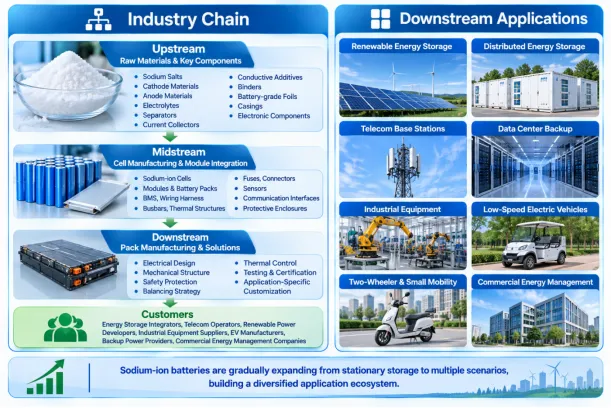
The industry chain includes upstream suppliers of sodium salts, cathode materials, anode materials, electrolytes, separators, current collectors, conductive additives, binders, battery-grade foils, casings and electronic components. Midstream participants manufacture sodium-ion cells and integrate them into modules and battery packs with battery management systems, wiring harnesses, busbars, thermal structures, fuses, connectors, sensors, communication interfaces and protective enclosures. Pack manufacturers are responsible for electrical design, mechanical structure, safety protection, balancing strategy, thermal control, testing, certification and application-specific customization. Downstream customers include energy storage system integrators, telecom operators, renewable power developers, industrial equipment suppliers, low-speed vehicle manufacturers, backup power providers and commercial energy management companies. The value chain is still evolving because sodium-ion battery chemistry has not yet reached the same level of standardization as lithium-ion technology.
Downstream Applications
Downstream applications are mainly concentrated in renewable energy storage, distributed energy storage, telecom base stations, data center backup, industrial equipment, low-speed electric vehicles and selected two-wheeler or small mobility markets. In renewable and distributed storage, sodium-ion battery packs can support solar and wind power smoothing, peak shaving, off-grid systems and commercial energy management where cost, safety and stable supply are critical. Telecom and backup power applications benefit from sodium-ion batteries because they can perform well in broader temperature conditions and reduce reliance on expensive lithium resources. Industrial equipment and low-speed mobility applications may adopt modular packs when buyers require safer chemistry, moderate range and lower long-term material cost. The technology is less likely to replace high-nickel lithium batteries immediately in premium passenger electric vehicles, where energy density remains a key constraint. Instead, early adoption is expected in price-sensitive, safety-focused and stationary scenarios, gradually expanding as cell performance, pack design and customer validation improve.
Modular Sodium-Ion Battery Pack Report Chapter Summary:
Chapter 1: Modular Sodium-Ion Battery Pack Industry Definition and Market Overview
This chapter clearly defines the product definition, characteristics, and industry statistical scope of Modular Sodium-Ion Battery Pack, systematically introduces its mainstream product classifications and key application areas, and presents the overall size and future outlook of the global market.
Chapter 2: In-depth Analysis of Core Modular Sodium-Ion Battery Pack Companies (2021-2025)
This chapter focuses on the main players in the Modular Sodium-Ion Battery Pack market. For each representative company, it not only introduces its basic overview, main business, and product portfolio, but also highlights its core operating data in the Modular Sodium-Ion Battery Pack field, including sales volume, sales revenue, pricing strategies, and the latest development trends of the company from 2021 to 2025.
Chapter 3: Global Competitive Landscape Analysis (2021-2025)
This chapter examines the global Modular Sodium-Ion Battery Pack competitive landscape from a macro perspective. By comparing the Modular Sodium-Ion Battery Pack sales volume, pricing, revenue, and market share of major companies from 2021 to 2025, it quantitatively analyzes market concentration and interprets the competitive strategies and market position evolution of core manufacturers.
Chapter 4: Modular Sodium-Ion Battery Pack Major Regional Market Size and Prospects (2021-2032)
This chapter conducts a regional-level analysis of the global Modular Sodium-Ion Battery Pack core markets. It will present historical data on the Modular Sodium-Ion Battery Pack market size (sales volume and revenue from 2021-2025) in major regions such as North America, Europe, and Asia Pacific, and provide market outlook forecasts for 2026-2032.
Chapter 5: Modular Sodium-Ion Battery Pack Product Type Segmentation Market Forecast (2021-2032)
This chapter delves into the Modular Sodium-Ion Battery Pack product structure. It will segment the Modular Sodium-Ion Battery Pack market by different types (such as Cylindrical Cell Modular Sodium-Ion Battery Pack、Prismatic Cell Modular Sodium-Ion Battery Pack、Pouch Cell Modular Sodium-Ion Battery Pack, etc.), and analyze in detail the historical market size of each segmented product category from 2021 to 2025 and the future growth trends from 2026 to 2032.
Chapter 6: Modular Sodium-Ion Battery Pack Application Field Segmentation Market Forecast (2021-2032)
This chapter delves into the downstream application demand for Modular Sodium-Ion Battery Pack. The market will be segmented by different application areas (such as Residential and Commercial Storage、Industrial Stationary Storage、Mobile Power Equipment、Others, etc.), presenting the historical market size for each area from 2021-2025 and future demand forecasts from 2026-2032.
Chapters 7-11: In-depth Analysis of Global Regional Markets (2021-2032)
This section is the core module of the Modular Sodium-Ion Battery Pack report, providing an in-depth country/regional analysis across five major regions: North America, Europe, Asia Pacific, South America, and the Middle East & Africa. The chapter structure for each region is consistent:
Segmentation by Country/Region: Analysis of the market size and forecasts for major countries within the region from 2021-2032.
Segmentation by Product Type: Presentation of the market structure and development forecasts for different product types within the region from 2021-2032.
Segmentation by Application Area: Analysis of market demand and prospects for different application areas within the region from 2021-2032.
Chapter 12: Global Modular Sodium-Ion Battery Pack Market Dynamics, Challenges, and Trends
This chapter aims to analyze the key internal and external factors affecting the development of the Modular Sodium-Ion Battery Pack market. It systematically reviews the core drivers of Modular Sodium-Ion Battery Pack market growth, the main obstacles and challenges faced, and assesses future product, technology, and market development trends.
Chapter 13: Modular Sodium-Ion Battery Pack Industry Chain Structure Analysis
This chapter analyzes the entire industry chain ecosystem of the Modular Sodium-Ion Battery Pack industry. From upstream raw material supply to midstream production and manufacturing, and then to downstream end-use applications, it analyzes the current status, cost structure, and collaborative relationships of each link.
Chapter 14: Sales Channel Model Research
This chapter focuses on the distribution channels of Modular Sodium-Ion Battery Pack products. It analyzes the market share, advantages and disadvantages, and typical cases of mainstream sales channels, and explores the innovation and development trends of channel models.
Chapter 15: Research Conclusions and Strategic Recommendations
As a summary of the report, this chapter will distill the core findings and conclusions of the entire report and, based on a comprehensive understanding of the Modular Sodium-Ion Battery Pack market, provide actionable strategic development recommendations for industry participants and potential entrants.
For more information, please refer to "Global Modular Sodium-Ion Battery Pack Market 2026 by Manufacturers, Regions, Type and Application, Forecast to 2032". This report analyzes the supply and demand situation, development status, and changes in the industry, focusing on the development status of the industry, how to face the development challenges of the industry, industry development suggestions, industry competitiveness, and industry investment analysis and trend forecasts. The report also summarizes the overall development dynamics of the industry, including the impact of the latest US tariffs on the global supply chain, the supply relationship analysis of the industrial chain, and provides reference suggestions and specific solutions for the industry in terms of products.
Previous News:
PIN-Type Photo Diode Market 2026: An 8.2% CAGR Points to a USD 1,519 Million Opportunity by 2032 as Optical Communications and High-Speed Detection Demand Accelerate
Next News:
Non-Methane Hydrocarbon Analyzer Market 2026: A 6.7% CAGR Points to a USD 501 Million Opportunity by 2032 as VOC and Ozone Pollution Control Policies Tighten
The copyright of this article belongs to Global Info Research. Without the written authorization of our company, no organization or individual may reprint, quote, copy, adapt or use it for commercial purposes in any way. When authorized to use, the original source must be indicated as "Global Info Research" and the complete copyright information must be retained.
- We Provide Professional, Accurate Market Analysis to Help You Stay Ahead of Your Competition.Speak to our analyst >>

Our Clients
What We Can Provide?
With better results and higher quality products,Our professional reports can achieve four things:

Insight into the industry market information

Analyze market development needs

Prospects for future development

Develop industry investment strategy
- Digging deeper into global industry information and providing market strategies.Contact Us >>
- We Provide Professional, Accurate Market Analysis to Help You Stay Ahead of Your Competition.Speak to our analyst >>
Our Clients
What We Can Provide?
With better results and higher quality products,Our professional reports can achieve four things:
Insight into the industry market information
Analyze market development needs
Prospects for future development
Develop industry investment strategy
- Digging deeper into global industry information and providing market strategies.Contact Us >>